
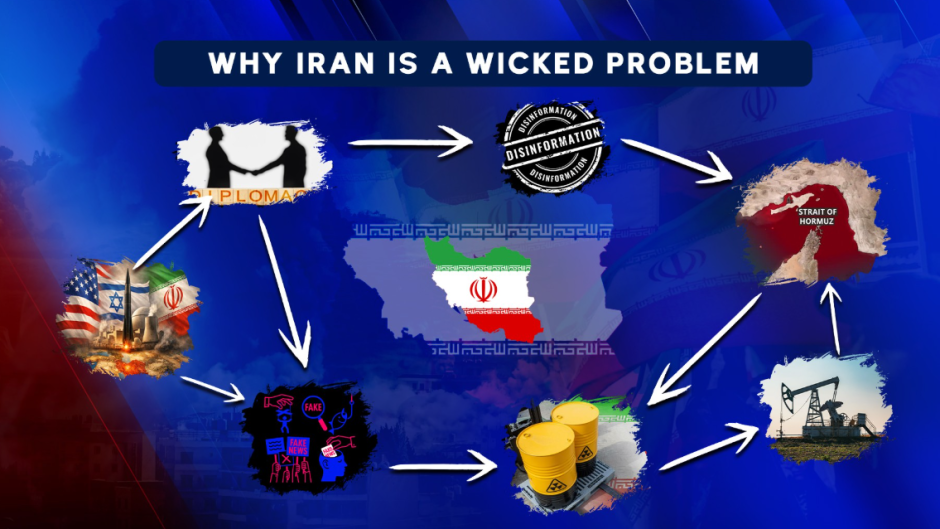
While the decision of the US and Israel to go to war with Iran is having a profound impact on all of us, even thousands of miles away.
And while hints and rumours of a deal come and go, it’s useful to step away from frustration with the players and oil price details and understand what’s happening through the lens of academic theory.
The theory of wicked problems or crises can explain why Iran has opened a Pandora’s box of problems for the world, and why US President Donald Trump has backed himself into a corner and may have to settle for a suboptimal deal.
Modern problems like cyber insecurity, disinformation and climate change are seen as ‘wicked’ not because they’re evil (although many are) but because they’re extreme and complicated.
Sometimes it’s hard to articulate what the problem is, never mind the solution. The stakes are massive, but in the face of no clear answers, there are divergent views, so wicked problems are marked by being political and divisive.
They spill over institutions, country boundaries and policy fields.
Covid19 was a global health and science problem momentarily, until lockdowns made it an economic, business, policing and political problem.
It even became a sporting governance problem when Novak Djokovic chose not to be vaccinated. Wicked problems often become everyone’s problem, which is why the DA’s mayoral candidate in Johannesburg, Helen Zille, is being asked about the genocide in Gaza and why journalists, actors and politicians around the world have lost their jobs over this issue.
Iran itself is a wicked problem, inside and out.
There is no doubt Iran has enriched uranium way beyond what it needs for peaceful nuclear use. The late Supreme Leader Ayatollah Ali Khamenei reportedly didn’t want to go all the way to nuclear weaponry.
However, his death at the hands of the US and Israel has sparked fears that his son and the Islamic Revolutionary Guard Corps now have the power they need to reverse his policy.
After Iran was bombed by two nuclear-armed states, in the midst of negotiations, the Quincy Institute for Responsible Statecraft told CNN, ‘the nuclear fatwa is dead.’
Part of the wicked problem of nuclear capability is that uranium can be enriched underground and hidden.
Last year, the US hit nuclear complexes that significantly increased the theoretical time it would take for Iran to make an actual bomb.
But Iran is still believed to have enough enriched uranium in the country that could be enriched further to ultimately make ten bombs, and the war has done nothing to change that.
In early May, intelligence sources told global news agency, Reuters, that two months of war had done little damage to Iran’s nuclear power program. To kill Iran’s nuclear programme, the US will not only have to find the enriched uranium but also kill everyone who knows how to make more.
If anything, Iran may have succeeded in making more people realise that the notion that its ok for the US and Israel to have nuclear weapons - but not for Iran - is a global norm that can, in fact, be challenged.
Another great irony is that Iran, which does not believe in press freedom and restricts the internet, has reportedly sponsored AI-generated Lego music videos that have arguably been powerful anti-US propaganda.
Iran’s geographical position has given it a unique ability to control the Strait of Hormuz and to target energy infrastructure in its crucial region.
Both Iran and Israel have fanatical leaders who can draw on the religious beliefs of their followers, and each country would like the other to be wiped off the face of the earthy. It all makes for a most wicked problem indeed.
Wicked problems come with a built-in dilemma.
By definition, they can only be addressed collectively. No single person, institution, or country can fix them because they operate across many dimensions and many states, and no single player has enough knowledge to understand how they really work.
The problem is that collaboration and global solutions have so often failed. So wicked problems have an inherent dynamic that undermines the ability needed to deal with them. An academic, Renate E Meyer, calls it a dangerous conundrum.
Since collaborative efforts have often fallen flat, but wicked problems are still standing, they play into the hands of authoritarian leaders. Enter the ‘strong man,’ Trump.
The problem, since Iran is a wicked problem, he will fail if the US tries to act alone, as he has realised.
After starting a war that saw the Strait of Hormuz closed, Trump is now saying the problem of keeping it open should be shared with other countries.
He’s been trying to embroil other countries generally and Spain’s leader has pushed back the hardest, knowing that they can’t have decentralised collective action when one player is trying to inflict a hierarchy on the others.
The world abounds with Wicked Problems that make states dependent on each other.
The growing hacking ability of AI tools just adds to climate change, offshoring, tax avoidance, illegal trade and human trafficking.
However, a lack of consensus has undermined the ability of the world to act collectively, and it has created fertile ground for dictatorships.
Philosopher and political theorist Hannah Arendt looked at totalitarian regimes in the last century, but her analysis explains the rise of authoritarianism today.
Arendt understood that social fragmentation (itself a wicked problem) sets the stage because people are open to new ideologies when they can’t identify with or orient themselves through shared cultural norms.
The media, courts, government and universities used to create a semblance of a shared everyday reality.
While we didn’t all agree, at least there was a foundation, a set of shared facts, to debate upon. Trust in all these institutions has faded, though, opening up a battle for truth.
Disinformation and conspiracy theories abound and every picture, meme and news report has become disputable.
Rather than democratising media, social media has amplified extreme views. The algorithms have created echo chambers and ‘hyperconnectivity’ has pushed us all apart.
The theory of Wicked Problems explains why Trump, who said the war was ‘very complete, pretty much’ after two weeks, is still embroiled in a conflict that he seems to want to get out of.
He’s trying to check out, but he can never leave.
The problem is, without a ground invasion and forced regime change (and we know how those go), the best the US may get is an agreement whereby the uranium is given up and Iran allows for its nuclear programme to be monitored.
In 2015, then US-President Barack Obama negotiated such a deal and the UK, France, China, Russia and Germany were involved.
Iran was obliged to allow inspectors from the International Atomic Energy Agency to monitor any location.
In 2018, Trump threw the agreement out, thinking he could do better. As the economist wrote early on in the war, “what an indictment of his Iran policy that, eight years and two wars later, he has no better options.”
The situation seems little changed, three months after the US and Israel attacked. Now that’s a Wicked Problem for you.
By Francis Herd