
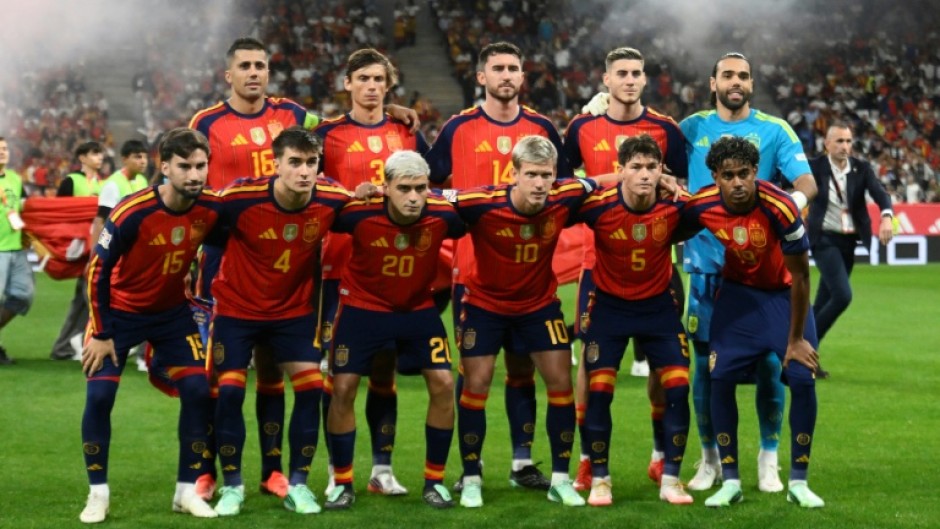
MADRID - Spain aim to extend their 43-match unbeaten run this week in the Nations League, with the playing philosophy that propelled them to World Cup glory this summer the product of years of work at every level of the game.
Their approach combines a clearly defined playing style, early talent identification and a coaching structure designed to ensure players learn the same principles as they progress through the youth ranks.
"For us there is clearly a turning point in 2008, when (then Spain national team coach) Luis Aragonés won the European Championship," David Gutiérrez, director of the Spanish football federation's (RFEF) national school of coaches, told AFP on a visit to their Las Rozas base.
Aragones's Spain played in a new way. The coach believed that Spanish players could not compete with their rivals physically, but were better suited for a system based on "ball control, collective play, positional play and combinations".
"He gave us a line to follow," said Gutierrez, with Spain going on to win the 2010 World Cup and Euro 2012, inspired by technically gifted players like Xavi Hernandez and Andres Iniesta.
This playing philosophy has endured, but in an open way to adapt to the evolution of football and the characteristics of new generations of players.
"In the end it's about evolving, in possession with high pressing, with transitions... evolving within modern football," said Aitor Karanka, the RFEF's technical director of development and the national team.
The result is a system in which the playing model takes precedence over individual names, with young players taught its principles from an early age.
"Both boys and girls, from a very young age, have that ability to start understanding the game," said Gutierrez.
Karanka, Jose Mourinho's assistant at Real Madrid between 2010-2013, who also coached English sides including Middlesbrough and Nottingham Forest, believes this gives Spain an advantage.
"There are countries or nationalities where you really do have to explain much more to the player what you actually want, and the Spanish player, with three or four brushstrokes, already understands," he explained.
Finding talent
Identifying promising players early is a key part of the process, increasingly so as more youngsters are eligible to represent multiple countries.
A network of scouts and regional tournaments involving players as young as 12 helps the RFEF identify prospects, who are then monitored and tested in Spain's youth teams.
"The aim is to get it right as early as possible so we can start building cohesion in the group we believe is the strongest," said Manuel Fernandez, coordinator of Spain's youth national teams.
Communication with clubs is also important, with many of the fundamental principles shared even if individual teams have their own styles.
The RFEF has also established specific profiles for each position on the pitch.
"We've drawn up the characteristics of players in every position," said Javier Minano, director of the federation's talent and performance development department.
However, Fernandez stressed that those profiles are not rigid requirements.
"If there is a player who really stands out, who has a lot of abilities and is not exactly the profile we're looking for, then we bring him in to see him and see if he's capable of adapting to what we want from him," he clarifies.
By learning the same concepts throughout their development, players can rise more comfortably through the ranks.
Coaching continuity
This progression is made easier by the way coaches are managed within the RFEF, where the head coach of one age group acts as an assistant in another.
Under-21 coach, David Gordo, recently became a world champion with the under-16 side, while at the same time the under-15 coach, Hernan Perez, is Gordo's assistant with the under-21s.
"It's necessary for all the coaches to know as much as possible about every age group," explains Fernandez.
The senior national team is perhaps the clearest example of the benefits of that continuity.
Of the 26 players who won the World Cup under Luis de la Fuente this summer, 18 had previously been coached by him in Spain's youth teams.
The aim is to produce teams whose collective strength outweighs individual talent, with strong relationships between players cultivated throughout their development.
"More than the idea of a national team, what we are trying to create here is the idea of a team (in general)," said Karanka.
- AFP