
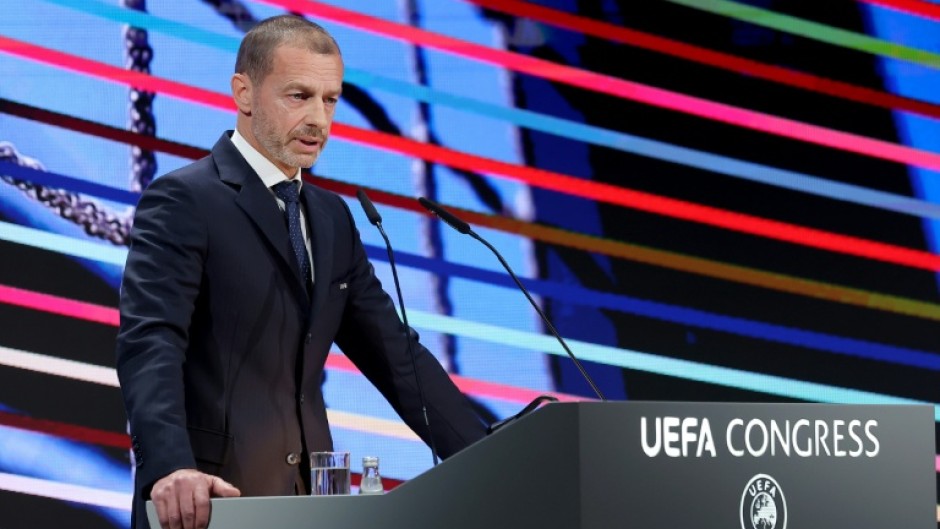
PARIS - UEFA president Aleksander Ceferin says one of his mantras is to "choose your battles", and he and European football's governing body have chosen the mother of all struggles in bidding to topple FIFA boss Gianni Infantino.
Ceferin may have decided to sit out the FIFA presidential election next March when Infantino will bid for a fourth and final term, but he and UEFA have selected their knight in shining armour -- French Football Federation chief Philippe Diallo.
The 59-year-old Slovenian has previously called himself an "underdog" leader, despite having been at the helm of UEFA since 2016 and pushed through a statute change which allowed him to run for a fourth term next year.
Nevertheless, to the many who disapprove of Infantino, the rather austere Ceferin has been a dynamic leader of the campaign to bring him down.
Infantino is under severe pressure for the first time, in part due to UEFA's reaction to his scrapped private investor plan.
UEFA's threat to boycott the World Cup if Infantino pushed through his proposals arguably led to the Swiss's humiliating climbdown in ditching the plan.
Terrence Burns, who served as brand and marketing strategist for two successful World Cup host bids, believes Ceferin emerged a big winner from the fallout.
"Ceferin played it well," Burns told AFP. "UEFA carried the fight collectively while he issued no personal statement at any point.
"The boycott threat was aggressive and credible, which is a rare pairing."
Ceferin served in the Yugoslav Army in the 1980s, before also being called up by the Slovenian forces during their War of Independence in 1991.
"Luckily I never had to shoot (anybody)," he once told ESPN.
Ceferin, who like Infantino is a lawyer by profession, will hope he has picked the right moment for his latest battle.
"I think you should in professional and private life, choose your battles," he told Politico last year.
"You should fight when it's really a reason to fight, but every fight is tiring."
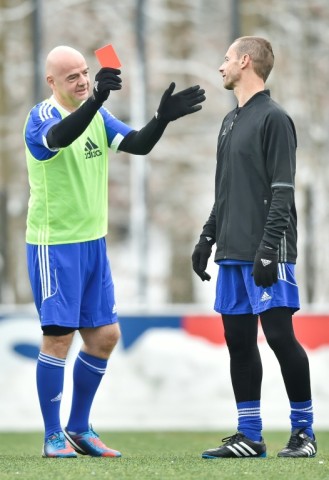
The World Cup may have been a huge success, but it also brought to a head simmering discontent with Infantino's style of leadership.
Indeed in September Ceferin compared Infantino to the emperor in the Hans Christian Andersen fairy tale "The Emperor's New Clothes".
Ceferin boycotted the World Cup final in protest, largely over the controversy surrounding Folarin Balogun's red card in the USA's last-32 win over Bosnia and Herzegovina.
At Trump's request, FIFA stepped in and suspended Balogun's ban, freeing him to play against Belgium in the last 16.
The decision led to widespread condemnation.
The successful taking down of the investment plan is not the first time Ceferin and UEFA have played a pivotal role in confronting FIFA under Infantino -- and won.
Their opposition, along with South American confederation CONMEBOL, in 2021 ultimately forced Infantino to scrap the idea of holding the World Cup every two years.
Ceferin also turned his fire effectively on the European Super League when proposals were floated in April 2021.
He was so angry about the failed breakaway, he called then-Juventus chairman Andrea Agnelli "a snake", even though he was godfather to the Italian's daughter.
"I didn't sleep, eat or drink for 48 hours, because I had phone calls with governments and royal families... and pressures and threats," he said in 2021.
Ceferin and UEFA, despite the quick collapse of the ESL, still felt obliged to reform their showpiece club competition, the Champions League.
Ceferin has had bumps in the road during his tenure since first being elected 10 years ago.
A UEFA statute change introduced in 2024 did not completely erase the three-term limit for the presidency, but stipulated terms started or served before July 1, 2017 should not be taken into account.
That paved the way for Ceferin to seek a fourth term next year, drawing criticism.
It sparked the resignation of Croatian football great Zvonimir Boban as UEFA's chief of football.
"Ironically, it was the UEFA president himself that proposed and launched a set of reforms in 2017 which were introduced to prevent such a possibility," said Boban.
"The reforms were to football's great credit, and that of the UEFA president. His shift away from these values is beyond comprehension."
- AFP