
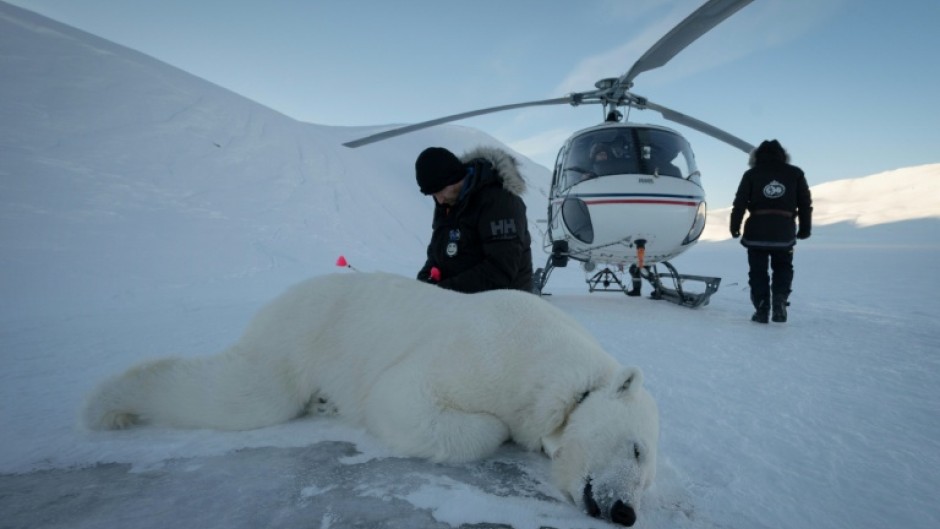
OSLO - A pioneering research mission is underway in Norway's Svalbard archipelago, where scientists, for the first time, took fat tissue biopsies from polar bears to study the impact of pollutants on their health.
The expedition came at a time when the Arctic region was warming at four times the global average, putting mounting pressure on the iconic predators as their sea-ice habitat shrank.
"The idea is to show as accurately as possible how the bears live in the wild -- but in a lab," Laura Pirard, a Belgian toxicologist, told AFP.
"To do this, we take their (fatty) tissue, cut it in very thin slices and expose it to the stresses they face, in other words pollutants and stress hormones," said Pirard, who developed the method.
Scientists said that while the study monitors all the bears, only females were tracked with GPS collars as their necks are smaller than their heads -- unlike males, who cannot keep a collar on for more than a few minutes.
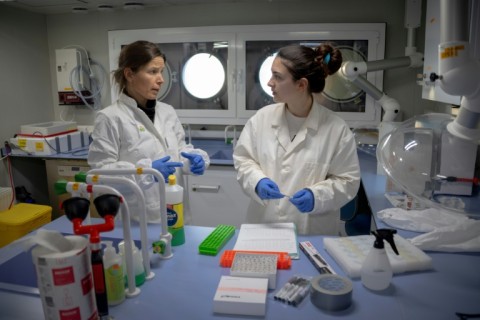
For the scientists aboard the Norwegian Polar Institute's research vessel Kronprins Haakon, these fleeting encounters were the culmination of months of planning and decades of Arctic fieldwork.
In a makeshift lab on the icebreaker, samples remained usable for several days, subjected to controlled doses of pollutants and hormones before being frozen for further analysis back on land.
Each tissue fragment gave Pirard and her colleagues insight into the health of an animal that spent much of its life on sea ice.
Analysis of the fat samples showed that the main pollutants present were per- and polyfluoroalkyl substances (PFAS) -- synthetic chemicals used in industry and consumer goods that linger in the environment for decades.
The team's findings may help explain how the bears' world is changing, and at an alarming rate.
Scientists estimate there are around 300 polar bears in the Svalbard archipelago and roughly 2,000 in the broader region stretching from the North Pole to the Barents Sea.