
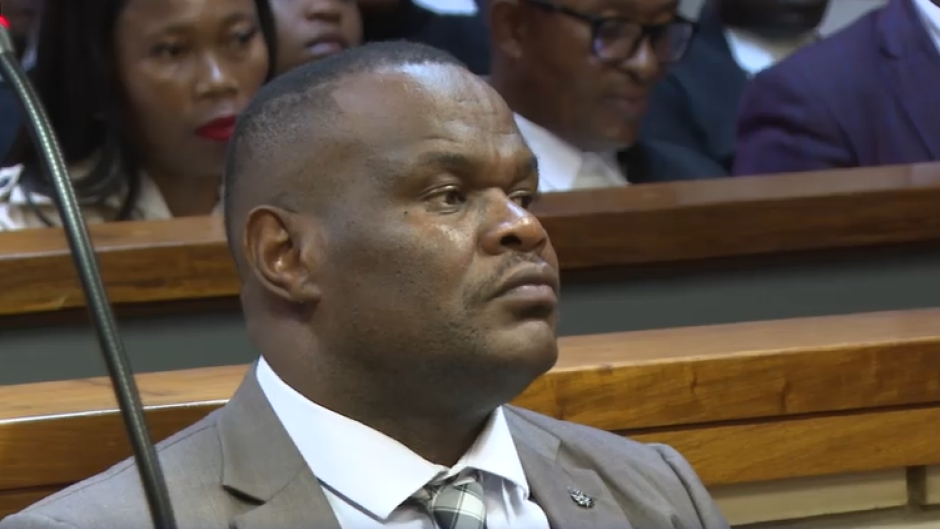
PRETORIA - Organised Crime Unit member Fannie Nkosi returned to court on Monday.
Alarming details emerged during his bail application, painting a disturbing picture of cases that appear to have gone cold.
The cases relate to dockets found when Nkosi was arrested. He was allegedly in possession of state-owned ammunition, a hand grenade, six case dockets, R50,000 in cash, and seven unsecured licensed firearms at his home.
Some of the dockets were linked to serious and violent crimes spanning nearly a decade.
READ | Court rejects Nkosi’s bid for prison hospital wing placement
These details were revealed when the state prosecutor at the Pretoria magistrate’s court read from an affidavit in court.
According to the state, one of the locations searched was a Wendy house structure, apparently used to store unwanted items.
This is where the dockets were found.
Stalled investigation
Three of the original dockets were linked to hijackings and robberies involving the British American Tobacco Company in Pretoria.
In one case from 2013, an employee delivering cigarettes valued at R44,000 to a tuck shop was allegedly approached by two suspects and instructed to hand over the car keys.
The suspects reportedly drove him to a secluded area, where the cigarettes were transferred into another vehicle.
Fingerprints of one suspect were found in the docket, and the individual had been identified.
However, the fingerprints were never submitted to the Local Criminal Record Centre (LCRC) for processing.
According to the state, the matter was postponed to 13 September 2016 for the attorney, with no further progress recorded.
In another case from 2014, cigarettes worth more than R280,000 were stolen.
Although CCTV footage was obtained and an identification parade arranged, no further investigations were conducted.
The suspect was never formally charged on the system, and no updates appeared in the docket.
A similar pattern emerged in a 2015 car hijacking case in Atteridgeville.
An employee of the British American Tobacco Company was allegedly targeted.
Fingerprints were lifted, CCTV footage was downloaded, and images of the suspects were filed, yet no further investigation followed.
From hijackings to heists
One docket details a 2022 cash-in-transit robbery in Roodepoort, where R620,000 was stolen from G4S Security, along with a company-issued firearm.
Another case relates to a 2022 cash-in-transit heist in Musina, Limpopo.
The docket includes a forensic image analysis report involving enhanced CCTV footage, as well as internal Correctional Services records.
According to the state, these documents were marked confidential and related to a disciplinary process involving an official responsible for the parole of one of the suspects arrested in the Musina robbery.
Even cybercrime left untouched
The files extend beyond violent crime.
In a 2019 cybercrime case involving the alleged hacking of a senior employee at the City of Tshwane Metro Police Department, a case was registered and the applicant reached out to a service provider.
However, no further investigation was conducted.
“He defeated the ends of justice”
The state prosecutor said Nkosi had been given the opportunity to return all state property after being notified of his suspension from the South African Police Service.
However, he allegedly failed to do so.
READ | 'It's a red flag': Police probe why Fannie Nkosi was in possession of dockets despite
The state argues that this conduct amounts to defeating the ends of justice.
Matter remanded
Nkosi is expected back in court on 20 April for the continuation of his bail application.