
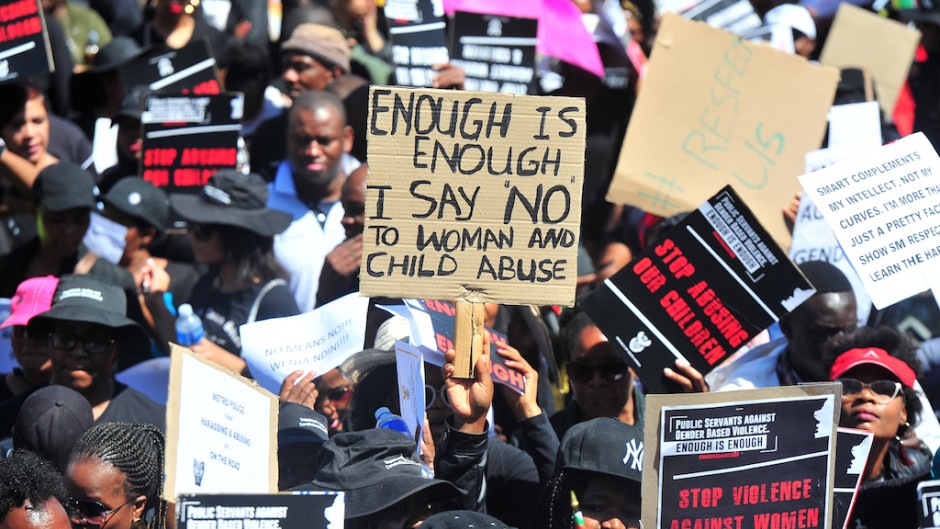
JOHANNESBURG - As South Africa observes the 16 Days of Activism for No Violence Against Women and Children, government’s declaration of gender-based violence and femicide (GBVF) as a national crisis has been welcomed.
Mpumalanga Representative for the National Shelter Movement of South Africa Sindisiwe Msimango says the move is long overdue.
“Naming GBV as a national crisis validates the lived realities of survivors and signals that the country can no longer treat GBVF as routine or isolated incidents — it is a national emergency requiring coordinated action,” she said
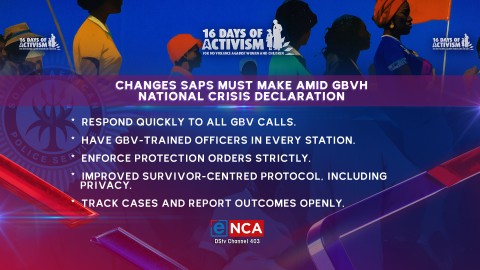
Msimango also highlights police stations, where survivors of GBV often report being turned away after officials fail to assist them.
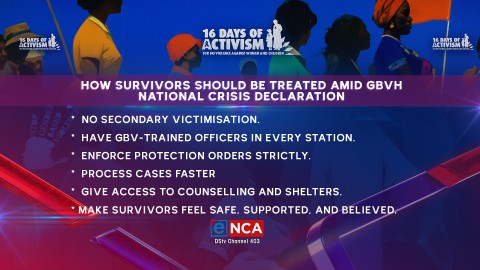
However, survivors and advocacy groups say this declaration must translate into real change for women and children who still struggle to access help at police stations.
READ| NGOs demand real action after GBV declared national disaster
While capacity exists within SAPS, she says it is uneven and often undermined by poor oversight, corruption, and inadequate training.
“Police must respond rapidly to GBV-related calls and treat them as high-risk emergencies. Leadership must demonstrate commitment not only through statements, but through decisive action, measurable performance standards, and enforcing consequences where officers fail survivors,” she added.
According to crime statistics for the fourth quarter (January to March), a total of 13,452 sexual offences were recorded. Of those 10,688 were rape cases while 1,872 were sexual assaults.
The National Prosecuting Authority (NPA) notes that while it is overwhelmed with cases, it has successfully handled and resolved numerous gender-based violence cases.
“The NPA prosecutes thousands of gender-based violence cases each year successfully," said Deputy NDPP Anton du Plessis.
"We also have a world-class Thuthuzela Care Centre model, linked to sexual offences courts, which has been emulated across Africa and globally.
"There are challenges. The scale of the crisis sometimes overwhelms the system, and we cannot prosecute our way out of this gender-based crisis.
"We need to change the societal norms that are driving it,” Du Plessis said.
While emphasising the NPA’s role in ensuring accountability, he said this is a nationwide crisis requiring collective action.
“It has to be led by men as well. Men in leadership roles, men in law enforcement, and men within the NPA,” he added.
While emphasising the NPA’s role in ensuring accountability, he said this is a nationwide crisis requiring collective action.
“It has to be led by men as well. Men in leadership roles, men in law enforcement, and men within the NPA,” he added.
Reiterating Du Plessis’s point, NPA Deputy Director of Public Prosecution Mkhuseli Jokani said that beyond prosecuting cases, everyone must take responsibility to raise awareness about gender-based violence in their communities.
“Gender-based violence has been declared a national crisis, so it cannot be business as usual. We need to mobilise men to take an active role in preventing violence and changing harmful social norms,” Jokani said.
Meanwhile, government has unveiled the National Strategic Plan to address gender-based violence, aiming for faster responses.
A backlog of over 50,000 DNA tests related to GBV cases will be prioritised.