
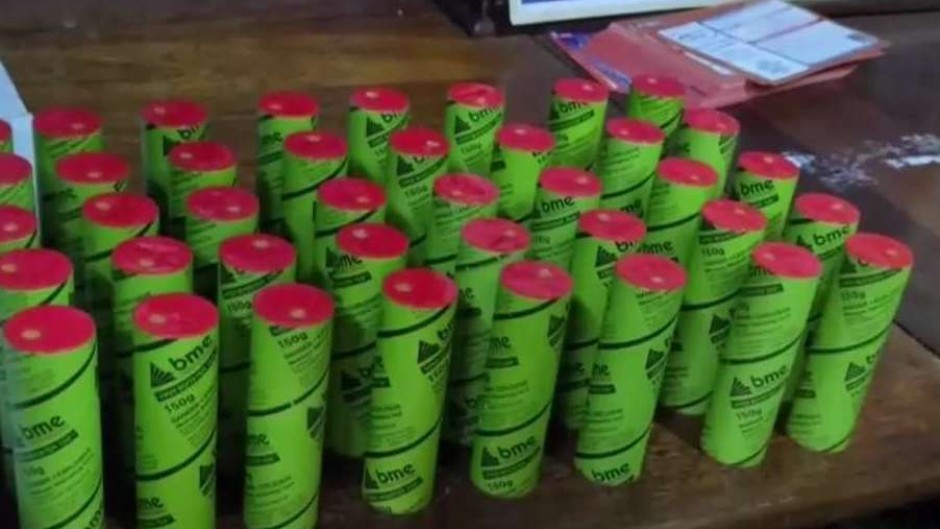
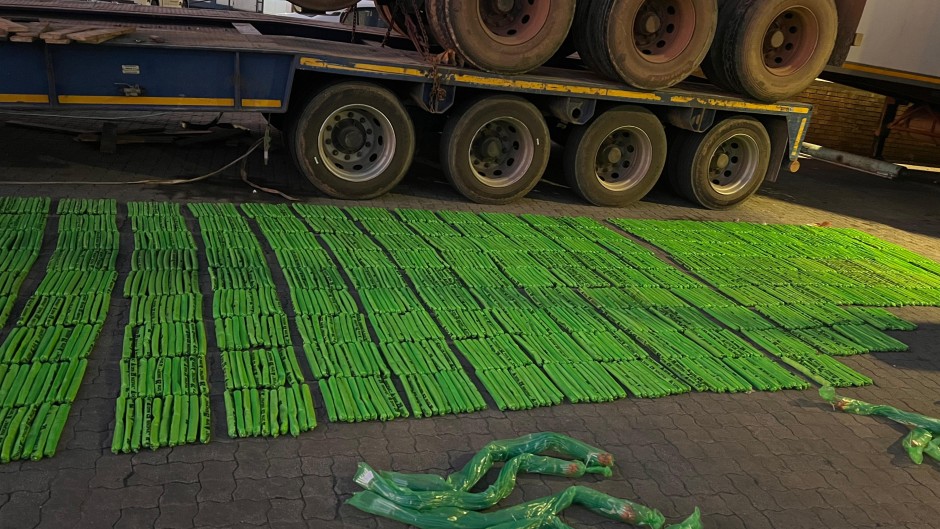
JOHANNESBURG - The seizure of explosives valued at R1 million at Beitbridge Port Entry early this week has raised concern over their possible use for illegal mining, cash-in-transit (CIT) heists and ATM bombings.
Authorities intercepted the truck at the port of entry into South Africa from Zimbabwe.
The mining explosives and detonators were hidden in a concealed compartment inside a trailer. The driver of the truck tried to flee but was arrested.
READ | Explosives worth R1m seized at Beitbridge
David van Wyk, from the Bench Marks Foundation, said focusing on low arrests risks missing the bigger picture.
“We keep on arresting truck drivers and zama zama's underground, but we're not actually dealing with a problem on the surface,” he said
Van Wyk believes that the likelihood of such explosives ending up in areas increasingly characterised by abandoned shafts is high.
This, he said, brings forth the question of whether the Department of Mineral Resources is failing to grip illegal mining?
“These towns, apart from the fact that the towns are dying, the mines are unrehabilitated, they are not properly closed," he said.
He said the department must work on closing off these mines and rehabilitating them.
At the same time, transitioning some of these towns from mining to post-mining activity.
“This will keep the populations in these towns active so that they don't resort to going back into underground activities and so on,” he added.
He challenged the perception that illegal mining is only driven by foreign nationals, saying that such crimes are more complex in reality
“Mining is a multinational exercise. It involves foreigners and locals, including illegal mining. And of course, the other thing is that we have lots of people who have been retrenched, more than 200,000 people have been retrenched in the last 10 to 15 years from mining, where mine shafts and so on have closed down.
“These are people that were here as legal migrants who then become illegal foreigners in the country because they lose their permits, their job permits and so on to be in the country. But the only skill that they do have is mining,” he said.
Meanwhile, Fidelity Service Group CEO Wahl Bartmann said the CIT industry has experienced a marked increase in the use of explosives in criminal incidents since around 2017.
He described the crimes as highly sophisticated.
“Criminal operations have become increasingly sophisticated and brazen, with perpetrators demonstrating higher levels of coordination, planning, and access to resources. These criminal activities are well organised syndicates operating with military precision,” Bartmann explained.
He warned that the use of explosives in populated areas poses significant risks, including serious injury or loss of life due to blast impact and flying debris, as well as damage to surrounding property.
READ | SANDF patrols abandoned mine shafts
According to Bartmann, they are working closely with authorities and industry partners to address and mitigate this threat.
“Fidelity continuously enhances its security strategies through the upgrading of onboard vehicle technology, the deployment of more robust and reinforced vehicles, continuous in-depth training of our CIT officers, and the integration of air support with Fidelity helicopters, tactical ground support teams, and intelligence-driven operations.
"This multi-layered approach contributes to a strong operational success rate,” he said.