
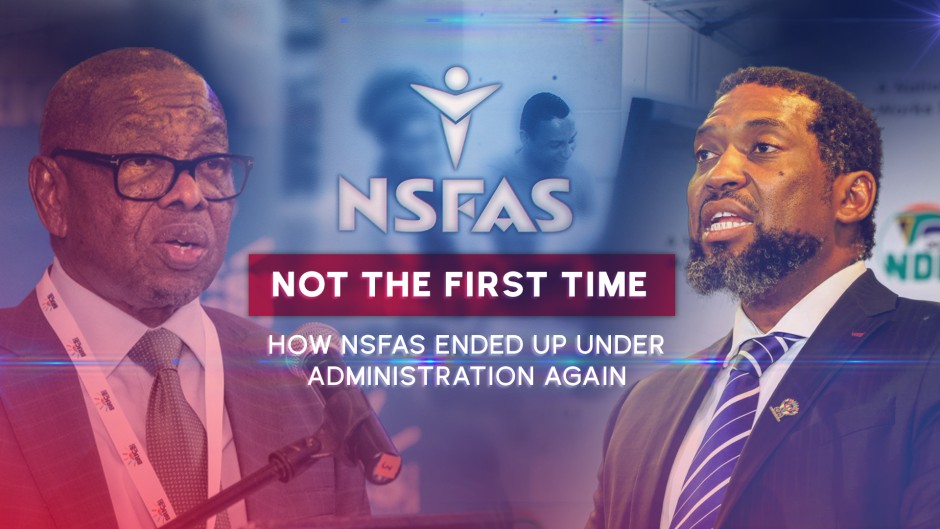
JOHANNESBURG - When Minister of Higher Education and Training Buti Manamela announced on Monday that NSFAS would be placed under administration, the decision was not unprecedented.
In fact, it exposed once again the cracks in one of the country’s student funding bodies that funds millions of students.
The 2024 blow
The first time NSFAS was placed under administration was in April 2024, with the former Minister of Higher Education, Blade Nzimande.
Nzimande, at the time, also announced that the board would be dissolved, with Sithembiso Freeman Nomvalo appointed as the new Administrator for NSFAS.
Nzimande flagged his unhappiness towards the board at the time, saying they had failed to carry out basic responsibilities allocated to them.
READ | Discussion | Education in Crisis | Nzimande dissolves NSFAS board
This included the inability to oversee student allowance payments, the inability to address capacity deficiencies, and the inability to implement Werksmans Report, key among which is the termination of the contracts of the direct payment service providers, who had been appointed irregularly.
READ | NSFAS | Students left stranded without accommodation
Nomvalo's task at the time included taking over governance, management, and administration for 12 months, including, among other things, addressing operational challenges and finalising funding decisions and outstanding payments.
The problem did not begin overnight.
Fast forward, two years later, and the country is singing the same song again.
Manamela admitted that the concerns regarding the NSFAS board existed well into taking office in 2025.
He said the department even approached the courts through self-review proceedings concerning the process through which the Board had been constituted.
He cited that this was a decision driven by not turning a blind eye to alleged legal irregularities in the fund.
Cracks in leadership
As processes unfolded, cracks on the wall began to show, with leadership facing instability.
The board experienced a series of resignations, including the resignation of other members of the Board and the then Chairperson, Karen Stander, over allegations of a governance environment at Nsafas, including bullying, intimidation, racism, and threats to personal safety.
READ | NSFAS flags low interest in missing middle loan scheme
In an effort to stabilise governance and ensure continuity, Mugwena Maluleke was appointed Interim Chairperson and Deputy Chairperson in late 2025.
At the same time, broader institutional concerns at NSFAS continued to deepen, Manamela said
By March, the fund had faced further mounting concerns, including serious data integrity concerns, weaknesses in consequence management, and broader governance and accountability concerns.
In April 2026, when Maluleke resigned with immediate effect, citing personal and academic commitments, Manamela said, the governance situation deteriorated further.
“At that stage, I initiated a formal process in terms of section 17A of the NSFAS Act. Each remaining Board member was written to individually and afforded an opportunity to make representations regarding the governance position of the institution, possible alternatives, and whether intervention was necessary. Those representations were considered carefully,” Manamela.
In the same breath, he said the department considered alternatives to administration, including appointing further interim leadership, filling vacancies, allowing additional time for ordinary governance processes, and intensified departmental oversight
But none of these options were satisfactory, Manamela said.
The decision: administration
This led to the decision to place the institution under administration and appoint Professor Hlengani Mathebula as Administrator of NSFAS.
“Professor Mathebula brings extensive governance, financial management, regulatory, and institutional leadership experience accumulated over more than three decades across both the public and private sectors.”
Manamela was clear on the mandate of Mathebula, which is to focus on stabilisation, accountability, operational continuity, and institutional renewal.
He said the administration is intended as a temporary but necessary intervention to restore institutional credibility, operational effectiveness, and public confidence in NSFAS.