
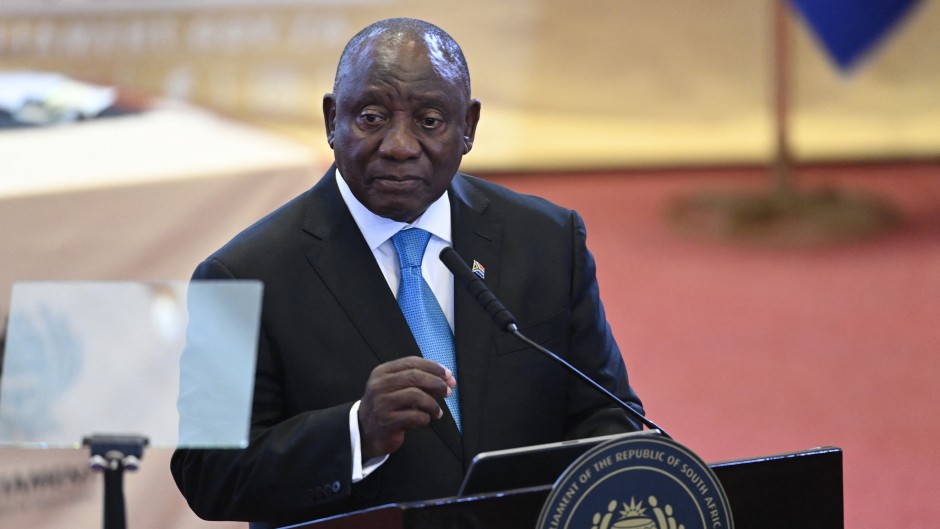
JOHANNESBURG - President Cyril Ramaphosa is taking the Constitutional Court judgment on the Phala Phala saga on the chin.
Barely two hours after the court issued its scathing findings, Ramaphosa issued a statement saying no one is above the law.
He cautioned, however, that any allegations should be subjected to due process without favour and prejudice
But how true will these words ring when he has to face the impeachment committee, and will the story behind the money allegedly stashed in his couch finally come to rest?
The Constitutional Court has once again affirmed its role as the ultimate custodian of accountability.
On Friday, the highest court of the land ruled that Parliament’s Phala Phala vote was invalid and unconstitutional.
This is a judgment that has now set the stage for the most consequential moment for Cyril Ramaphosa’s Presidency, facing the Parliamentary Impeachment Inquiry.
Handing down the landmark ruling, Chief Justice Mandisa Maya said Parliament must amend Rule 129(i) of the National Assembly’s rules and refer the matter to an impeachment committee.
READ | ConCourt sets aside National Assembly vote on Phala Phala
Rule 129(i) governs the process for removing a President, in terms of Section 89 of the Constitution.
Legal analyst Benedict Phiri said the judgment fundamentally changes the impeachment process and closes the door on political protection through parliamentary voting.
“What the court basically found today was that once the independent panel had made its finding that there was a prima facie violation of the Constitution. It wasn't up to Parliament to actually create a process which would then essentially allow the President to escape accountability,” he said.
Phiri said Parliament now has to remedy the defect with Rule 129(i).
The amendment will subsequently impact the impeachment of any future sitting President.
“I don't think that Parliament has much leeway around what that amendment could potentially look like. Because the Constitutional Court was pretty clear that where there is a prima facie finding in that independent panel, it has to be sent directly to the impeachment committee to be dealt with. And there is no role for Parliament in that particular instance until after that impeachment committee has dealt with it”, he added.
Ramaphosa’s troubles began in 2020 when $580,000 was stolen from his Phala Phala farm near Bela Bela, Limpopo.
The independent panel found that Ramaphosa may have committed a serious violation of section 34(1) of the Prevention and Combating of Corrupt Activities Act.
Additionally, it found that he had failed to report the theft to police officials.
READ | Parliament to study Constitutional Court judgment on Phala Phala
The parliamentary impeachment committee will conduct fresh investigations following the Constitutional Court’s judgment.
The enduring questions that the committee will have to unpack include, among others, what is the source of the stolen money?
According to the panel’s report, the President’s version was that Mustafa Hazim, a Sudanese citizen, came to Phala Phala on Christmas Day 2019, carrying at least $580,000 in cash to buy buffaloes that were for sale.
But the question, as the independent panel put it, was how Hazim knew that there were buffaloes for sale at the farm? Was the sale advertised, and how did he know that the purchase price would be US$580,000?
Another burning question is why the housebreaking and theft were not reported for investigation.
Right now, Ramaphosa cannot appeal the ruling.
“This is a final judgment, a Constitutional Court judgment. Any move on that particular basis would not be a well-advised move. For the President, he has to prepare himself to appear in front of that impeachment committee and deal with whatever needs to be dealt with there,” Phiri said.