
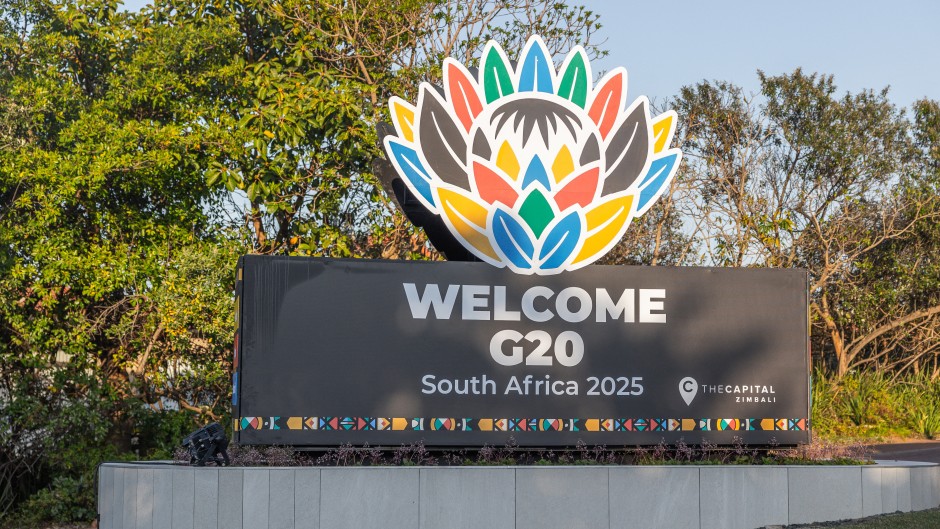
A general view of a sign welcoming delegates at the entrance of the G20 Finance and Central Bank Deputies and Finance Ministers and Central Bank Governors’ Meetings, at the Capital hotel in Zimbali, Durban
JOHANNESBURG - South Africa has existed as a unified territory since European colonisation, but achieved true democracy only on 27 April 1994, when all South Africans voted in the country's first fully democratic elections.
This historic transition marked the end of apartheid and the beginning of majority rule under President Nelson Mandela.
The current political system was established in 1996 with the adoption of the world's most progressive constitution, with extensive human rights protections.
President Cyril Ramaphosa has served as South Africa's head of state and government since 15 February 2018.
He was re-elected for a second term on 14 June 14 2024, following the African National Congress's formation of a Government of National Unity with opposition parties after losing its Parliamentary majority.
Under the constitutional democracy, Ramaphosa serves as both head of state and government, elected by the National Assembly to lead the executive branch.
South Africa maintains its position as Africa's largest economy with a GDP of around USD 400.26 billion in 2024.
However, the economy faces significant challenges, with GDP growth remaining subdued at just 0.8% quarter-on-quarter in Q2 2025, improving from a minimal 0.1% growth in Q1.
The economy expanded by only 0.6% for the full year 2024, marking the slowest growth since 2020. Economic forecasts for 2025 have been revised down to 0.9% annually, reflecting weak global conditions and insufficient progress in infrastructure improvements.
South Africa is a founding member of the G20 and is the only African country in the group.
READ | #KnowYourG20 | Germany, the home of Fanta and Gummy Bears
South Africa assumed the G20 presidency on 1 December 2024 and will host the historic G20 Johannesburg Summit on 22-23 November 2025. This will be the first G20 summit held on African soil.
Under the theme "Solidarity, Equality, Sustainability," South Africa is prioritising inclusive economic growth, food security, and artificial intelligence for sustainable development.
President Ramaphosa has committed to placing Africa's development at the top of the agenda during South Africa's Presidency.
5 Fun Facts About South Africa:
- South Africa's constitution recognises 13 official languages, including SA SIgn Language, illustrating the nation's linguistic richness and earning it the nickname "Rainbow Nation" for its cultural diversity. Heritage Day on September 24 celebrates this diversity with traditional braais (barbecues) and cultural dress
- South Africa achieved universal suffrage in 1994, making it one of the world's newest democracies despite having one of the most progressive constitutions globally. The transition from apartheid to democracy is considered one of the most remarkable peaceful political transformations in modern history.
- South Africa is home to the famous Big 5 (lion, leopard, elephant, rhino, and buffalo) in numerous national parks and private game reserves. The country's 2,500km coastline also features whale watching in Hermanus and African penguin colonies at Boulder's Beach in Simon's Town.
- Xhosa culture features complex dressing that portrays social status and marital position, while young men undergo traditional rites of passage. The country's diverse cultures, from Zulu shield-bearing warriors to the San people's hunting traditions, maintain vibrant ceremonial practices.
- South Africa operates a unique three-tier government system with national, provincial, and local levels all having legislative and executive authority in their own spheres. The country has advisory bodies from traditional leaders operating at both national and provincial levels.
By Nkateko Muloiwa