
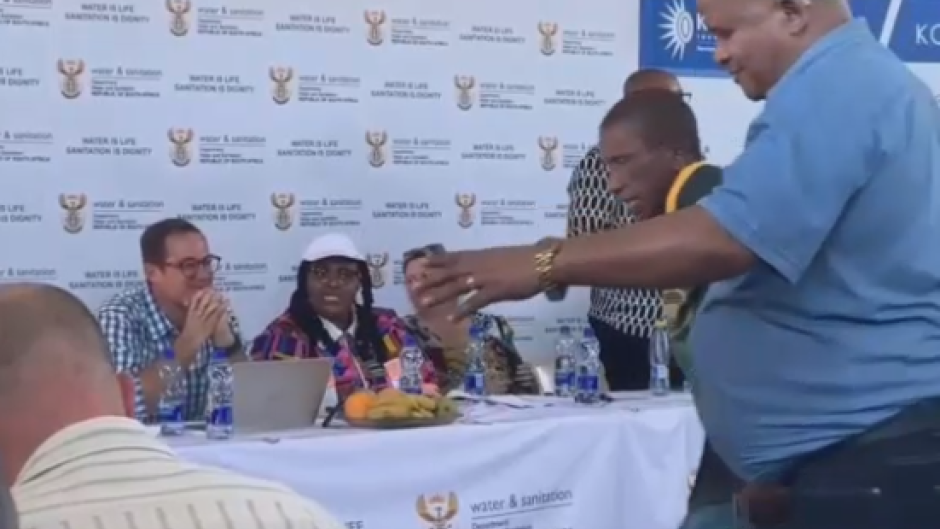
JOHANNESBURG - Questions are being raised about how politicians should conduct themselves when engaging with angry or frustrated communities, following heated exchanges involving Water and Sanitation Minister Pemmy Majodina and Johannesburg Mayor Dada Morero.
Both incidents have sparked debate over whether public officials should be held to a higher standard when faced with provocation from residents.
Majodina came under scrutiny after she exchanged profanities with a community member during an engagement in Kouga in the Eastern Cape.
The incident happened at the launch of an upgraded pump station by the Department of Water and Sanitation.
READ: 'Jou ma se ****' - Pemmy Majodina loses cool during community engagement
Political analyst Jan-Jan Joubert says politicians should expect difficult and sometimes confrontational interactions with members of the public.
“They sign up for it,” he says.
Joubert says that while many South Africans rarely have direct contact with politicians, emotions can run high when communities do get the opportunity to confront their leaders.
He says politicians who feel provoked should consider taking a diplomatic approach and involve other officials to help de-escalate the situation.
The incident involving Majodina is not the first recent example of a senior political figure losing their temper during a community engagement.
In August, Johannesburg Mayor Dada Morero told a community member during a public meeting in Tshepisong that they were “talking sh**”.
READ: 'You are talking sh*t’: Morero apologises after heated Tshepisong exchange
The meeting was held to address ongoing electricity problems affecting the community.
A resident called Morero a thief, an allegation the mayor repeatedly denied while asking the resident to retract the statement. When the resident persisted, Morero responded: “You are talking sh**.”
Morero later apologised publicly for his comments.
President Cyril Ramaphosa also condemned the mayor’s utterances as unacceptable, while acknowledging his apology.
“Our mayor has made utterances which we find completely unacceptable, but he has apologised. He’s gone public and apologised and we, as the ANC, have taken him up on that,” Ramaphosa said during a campaign in the same area.
The Department of Water and Sanitation has not commented on the incident involving Majodina.
Political analyst Prof Sipho Seepe says the incidents raise broader questions about the relationship between public officials and the communities they serve.
“What we are seeing is what is often referred to as the arrogance of power,” says Seepe.
He says this is partly driven by a misunderstanding of the relationship public officials should have with citizens and voters.
Seepe says the incidents involving Majodina and Morero could reflect a perception among some politicians that they are above the people they serve.
Joubert says politicians should never be seen to be at war with the public.
“What these two outbursts show is that politicians are out of touch with the public,” he says.
“They are surrounded by officials who often tell them how great they are, rather than the honest message of what people think about how they do their jobs,” he says.
Joubert says politicians often engage with the public most frequently during election campaigns, which can contribute to a disconnect between leaders and communities.
He says the President should also address Majodina’s conduct.
“The President is quite aware of the public’s anger, even among the judiciary,” says Joubert.
With the country heading into an election season, there are growing calls for consequence management and greater accountability when public officials engage with communities.