
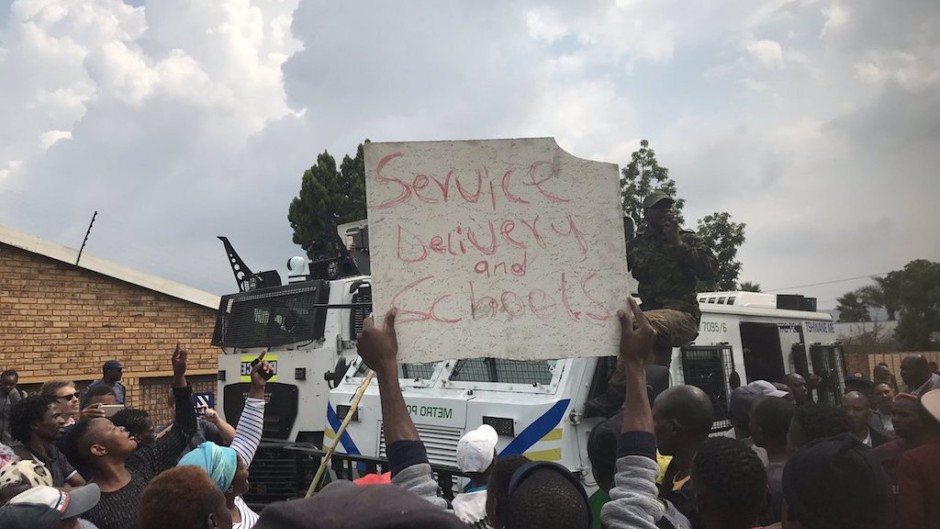
JOHANNESBURG - The gravy train may be halting for many, but the elite are using protests for their political benefit. That is according to the latest research from the New South Institute.
While many South Africans taking to the streets have legitimate grievances, political elites have managed to turn those grievances into something that can advance their own ambitions.
"We are certainly not discounting real grievances over services," says the Director of New South Institute, Dr Ivor Chipkin.
READ: Unemployment, migration concerns drive March and March protest
"We are saying that elites within political parties are able to take advantage of these local disputes," he adds.
These conflicts are then used as battles for power and position within political parties. Chipkin says the Institute has, for years, been trying to gather data from service delivery protests.
Around 2008 and 2009, the Institute discovered a massive spike in service delivery protests.
"Much of the academic literature frames it as an insurgency by the poor and working class," says Chipkin.
Chipkin says this frames it as an insurrection by the poor and working class, while some of the causes of these protests are more complex. The Institute noticed something unusual.
Protests peak
Around 2012 and 2013, protests peaked again. They then stabilised at a lower level and remained low until 2017, before going through the roof again in 2018.
In 2021, they peaked again in Durban and Johannesburg. According to Chipkin, “service delivery” protests have remained high since then.
A key driver of protests in 2021 was the Zondo Commission and former President Jacob Zuma’s arrest.
Reduction of service delivery protests
Chipkin explains that the reduction of service delivery protests in other periods was not the result of improved services. In many instances, the protests were meant to destabilise internal politics and had very little to do with improving citizens’ lives.
While many of the protests show a correlation to what is happening inside the ruling ANC, former President Jacob Zuma was, and still is, skilled at using patronage and internal resources to destabilise rivals.
President Cyril Ramaphosa is, upon closer inspection of the data, unable to reduce or manage contestation within the ANC in the way Zuma did.
"There is what is called the power elite during Zuma's period and then it fragments as Ramaphosa comes into power," says Chipkin.
According to Chipkin, Ramaphosa appears not to want to use corruption in the same way, nor does he want to use violence in the same way.
Dry taps leading to rise in organised crime
"We see the fragmentation continuing," he says.
One factor causing protests is that people who often got jobs through their affiliation with the ANC can no longer do so as taps are closing, partly due to the Government of National Unity (GNU).
People are now accessing resources through other means, including organised crime.
"That is why we are seeing much more aggression and more organised forms of crime taking hold," says Chipkin.
"We are seeing partisan relationships between senior generals, brigadiers and organised criminals," he adds.
The consolidation and deepening of South Africa’s multi-party democracy are occurring alongside the growth of organised crime.
Service delivery protests still matter
While many might criticise the study for taking attention away from legitimate grievances, Chipkin says the criticism is valid.
"We do not want to downplay the real dissatisfaction and grievance of ordinary South Africans," he says.
READ: Poor maintenance holding back service delivery: Planning Commission
"We have not done so in this paper; we have simply introduced elements which explain it," he adds.