
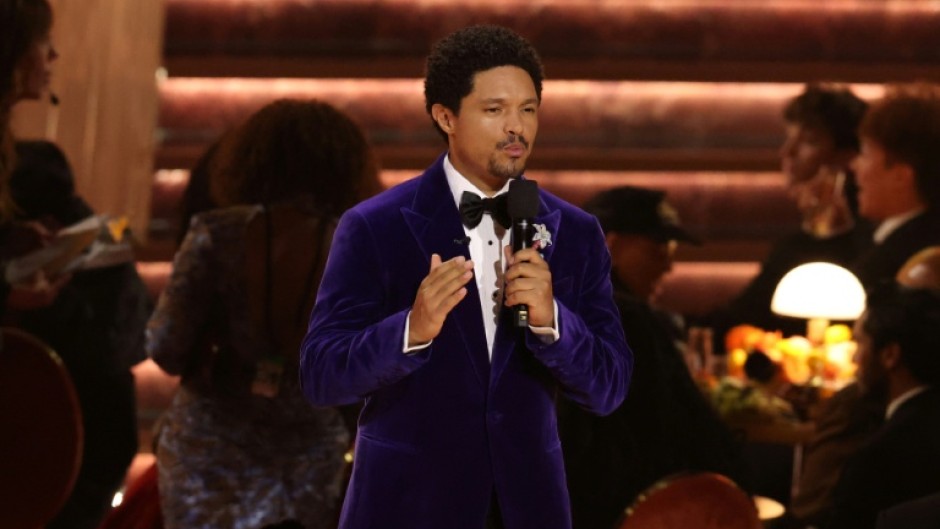
JOHANNESBURG - US President Donald Trump has long been a favourite punchline for comedians.
But a joke made at the 68th Grammy Awards struck a nerve, prompting the US president to threaten legal action.
Trump has taken aim at Grammy Awards host Trevor Noah over a comment linking him to convicted sex offender Jeffrey Epstein.
READ | Trump threatens legal action against Trevor Noah over Epstein comment
After congratulating Billie Eilish on her Song of the Year win, Noah joked that the Grammy was “almost as much as Trump wants Greenland,” referencing Trump’s past comments about acquiring the autonomous Arctic territory.
Noah then added: “Which makes sense because, since Epstein’s gone, he needs a new island to hang out with Bill Clinton.”
The comment quickly drew Trump’s attention.
Taking to his Truth Social platform, he first slammed the ceremony, saying the Grammy Awards were “the WORST and virtually unwatchable”.
He then criticised Noah directly, dismissing the joke as defamatory.
“I have never been to Epstein Island, nor anywhere close, and until tonight’s false and defamatory statement, have never been accused of being there — not even by the Fake News Media,” Trump wrote.
“Noah, a total loser, better get his facts straight, and get them straight fast.”
Trump went on to threaten legal action over the remarks.
Legal expert Ben Winks said Trump’s move is more complex than it may appear.
He explained that it is commonly misunderstood that while many statements may be defamatory, that does not necessarily mean they are wrongful or legally actionable.
"You can say defamatory things as long as they’re justified," Winks said.
Under US law, he explained, libel refers to written or published defamatory statements that cause damage to a person’s reputation in the eyes of the community.
“If I call someone a thief, that is defamatory, but it may be justified on the basis that it is true,” Winks said.
He added that the law also allows greater latitude for value judgments or opinions, such as criticising someone’s sporting ability.
"They don’t have to be held to a standard of exact truthfulness because they’re opinions," he said.
In Noah’s case, Winks said Trump’s potential complaint would not hinge on a literal claim that he visited Epstein’s private island.
Saying that someone was in a particular location is not, in itself, defamatory, he explained.
Instead, Trump would be suing over innuendo -- an implied meaning drawn from the remark.
In this case, the innuendo relates to Epstein’s status as a paedophile.
"So to say he went to Epstein Island or spent time on Epstein Island is to convey the innuendo that [Trump] engaged in sexual abuse of minors, (or he's associated in some way with sexual abuse of minors," Winks said.
"It is defamatory, but it may very well be justified. For example, if Mr Trump did spend time on Epstein Island, it may also be a fair comment if you consider it in the context of a joke and not meant to be taken literally or seriously."
Because Noah’s jokes are broadcast worldwide via streaming platforms, questions have also been raised about international law and cross-border jurisdiction.
Winks said Trump could theoretically choose a jurisdiction more favourable to his prospects of success.
READ | Epstein Files reveal Zuma allegedly had dinner with sex offender and model
“To overcome the difficulties of suing in the US, where the ‘actual malice’ requirement applies, he may prefer to sue in South Africa,” he said.
However, Winks doubts Trump would pursue that option.
“In South Africa, awards for damages are relatively low compared to the United States. It would also give Trevor Noah a home-ground advantage, and our jurisprudence is strongly protective of free speech,” he said.