
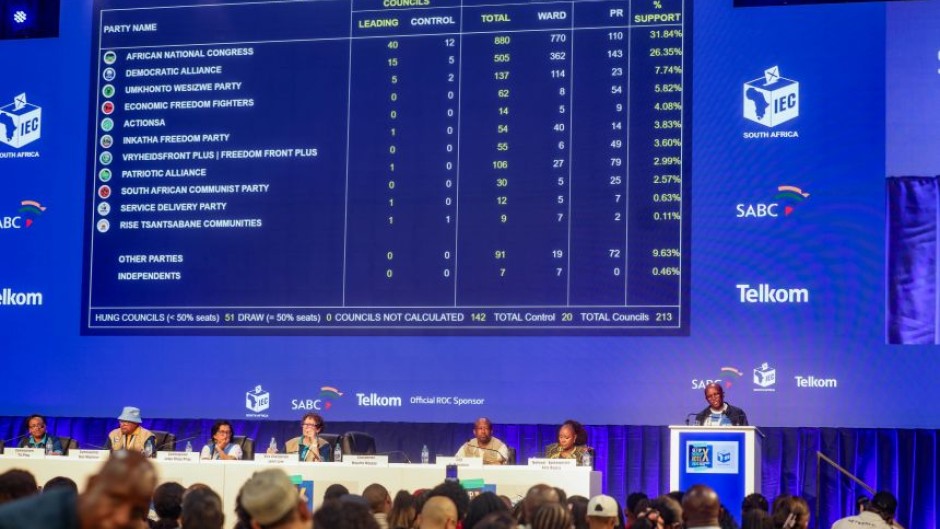
JOHANNESBURG - As the final votes come in, political parties are turning their attention to their seat allocations in municipal councils.
The final allocation of council seats should broadly reflect each party’s share of the vote. But what happens when a party wins more wards than the number of seats it would normally be entitled to under proportional representation?
This is known as an overhang.
READ: eNCA MarkData | Coalition talks loom as votes are counted
Overhang explained
The number of seats in a council is calculated to reflect the proportional election results. However, a ward seat cannot be taken away from a party that has won it.
This means that if a party wins a large number of wards but receives a smaller overall share of the vote, it could end up with more ward seats than its proportional allocation would ordinarily allow.
READ: eNCA MarkData | ANC plummets as MK Party set to be eThekwini's big winner
In such cases, the party will not receive any additional councillors from its proportional representation (PR) list until the overhang has been accounted for.
This has happened before in Emfuleni, in the Vanderbijlpark and Vereeniging area.
Although the ANC won 38 ward seats, it received only 36% of the overall vote.
Because those ward seats could not be forfeited, the party ended up with two more seats than its proportional allocation allowed, resulting in an overhang of two.
READ: eNCA MarkData | DA leads ANC, ActionSA emerges in top three in Joburg
Consequently, no councillors were elected from the ANC’s proportional representation list.
The DA and EFF each also forfeited a proportional representation councillor to accommodate the ANC’s two-seat overhang.
The allocation is determined through a complex calculation set out in the regulations under the Municipal Electoral Act.