
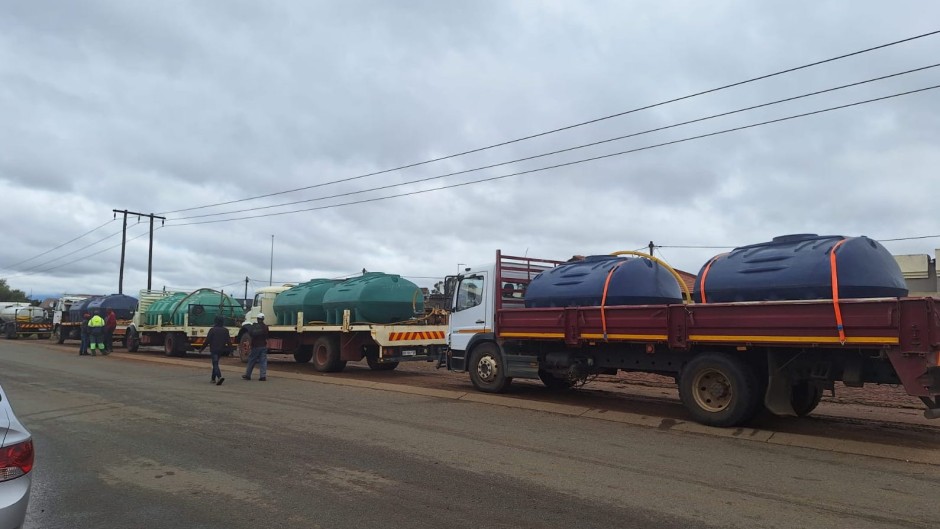
DURBAN - The death of a 38-year-old man who was run over by a municipal water tanker in eMbumbulu in KwaZulu-Natal has sparked concerns over municipalities' reliance on water tankers.
Celani Zungu (38) died over the weekend during an incident that allegedly erupted when community members confronted the driver over a water delivery.
Residents claimed the limited supply should be shared with the wider community rather than delivered to a single household.
While police have now launched investigations into the circumstances surrounding the incident, the anti-corruption group Corruption Watch has exposed deeper governance failures and basic service delivery collapse, which continue to fuel tanker dependency.
READ | Fatal water tanker incident puts SA's water crisis in focus
According to Corruption Watch's, Janine Erasmus, the reliance on water tankers began as an emergency intervention, with municipalities outsourcing water delivery to private companies.
This, she said, was because of the deterioration of infrastructure and inadequate maintenance, which led to erratic water supply.
But what was meant to be a temporary solution has, in some areas, become a system vulnerable to corruption and abuse.
She said when tanker use happens frequently, and when delivery of the most basic services collapses and oversight is weak, communities become desperate.
This gives way to exploitation of the vulnerable.
“We see unscrupulous water vendors coming in to take advantage of that desperation, and accountability nowhere in sight. This is when such tragedies can happen,” Erasmus said.
Erasmus describes this as a weaponisation of water where a constitutionally prescribed right for all becomes subject to corruption.
READ | Family demands justice after KZN tanker death
In her argument, she pointed to the findings by the Auditor General showing how municipalities spent up to R2.32 billion on water tankering across 59 municipalities, of which R419-million was classified as irregular.
“The longer tankers are needed, the greater it becomes the financial incentive for the networks profiting from them to make sure the system never gets a lasting repair,’ she explained.
Erasmus did not mince his words; she said that where there is ongoing dependence, rather than implementing long-lasting fixes, there are those who benefit, including politicians, officials, and private contractors.
At the back of this issue are the procurement irregularities.
She said, while Corruption Watch has not so much identified water tanker procurement, there is a worrying and ongoing pattern in municipal procurement.
This, according to Erusmus, includes contracts awarded to companies with no track record or capacity, or tenders awarded irregularly and then having to be set aside by a court of law, causing more delays.
READ | Water tanker becomes centre of deadly tragedy in KZN
She said, based on Corruption Watch research into public procurement, that, among other things, emergency procurement bypassing normal competitive bidding is a big risk, conflicts of interest and political connections in tender awards, weak consequence management, as well as the intimidation of whistle-blowers and community activists.
Erasmus believes that municipalities should be legally required to report publicly on tanker spending and hold officials accountable through oversight committees.
At the same time, the provincial government should monitor municipalities that show chronic tanker dependency and intervene where infrastructure investment is being neglected in favour of recurring tanker contracts.
National oversight bodies also have a role to play in exercising their duties and responsibilities with even greater diligence in this sector.