
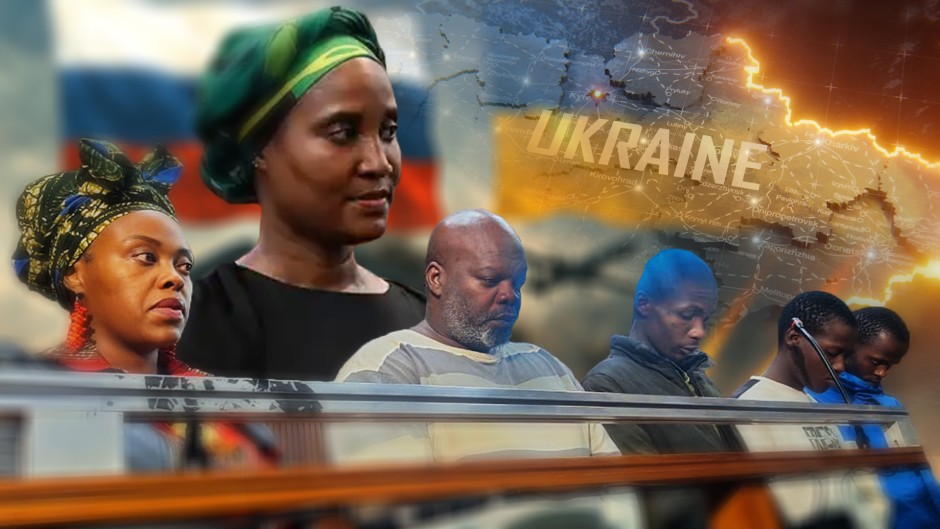
JOHANNESBURG - South Africans authorities continue to piece together evidence on how and why some citizens find themselves on the frontlines of the Russia-Ukraine war.
On Monday, five suspects – among them SABC radio presenter Nonkululeko Mantula and Thulani Mazibuko, Xolani Ntuli, Siphamandla Tshabalala, Sifiso Mabena, made their first appearances in the Kempton Park Magistrate’s Court on charges of foreign military assistance.
Their arrests coincide with allegations linking former President Jacob Zuma’s daughter Duduzile Zuma-Sambudla to the travel of 17 uMkhonto WeSizwe (MK) Party members allegedly sent to fight in Russia.
READ| UPDATE | War recruitment case postponed
Investigators are now trying to determine whether the men willingly volunteered to join the Russian armed forces or whether Zuma-Sambudla duped them into it.
eNCA spoke to Defence Analyst Dean Wingrin who painted a rather grim picture of the recruitment patterns.
Why South Africans are being targeted
According to Wingrin, South Africa has a long history of men joining foreign conflicts.
This he adds makes these “soldiers” attractive to overseas militaries.
He said during the Border War between South African and Angola in the 1980’s, soldiers gained invaluable combat experience.
When that war ended, many found themselves out of the Defence Force despite having skills useful only in combat, so they often went abroad, sometimes for financial reasons, Wingrin explained.
He added that South African soldiers are still highly regarded internationally.
“We saw this in the DRC, where on the ground, our soldiers acquitted themselves well.
"The tactics, logistics and strategic intent of that is another question, but on the ground, the soldiers were well regarded," he said.
READ| Second-last group of SANDF troops returns from DRC
With regard to Russia, Wingrin says the situation is different. “Russians are desperate for manpower and are less concerned whether recruits have military experience.”
How recruitment happens — and why it went undetected
Wingrin adds that Russia has cast a wide net across Africa, offering inflated salaries and promises of fast and free passports.
But the reality often does not meet the promise.
“Once recruits arrive, they often discover they’ve unknowingly signed contracts and, within a week or two, find themselves on the frontline.”
South Africa is not the only country affected.
READ | Putin says Russia will fight on unless Ukraine cedes land
“At least 1,500 Africans are fighting for Russia — from Nigeria, DRC, Mali, Sudan, Ethiopia, and Zimbabwe.”
Of concern to Wingrin is why these recruitment activities were not detected earlier, given South Africa’s functioning intelligence services.
He notes that both Russia and Ukraine actively seek foreign soldiers and that South Africa’s strong ties with Russia should have put the matter on local intelligence radars.
South Africa’s legal framework
South Africa’s Regulation of Foreign Military Assistance Act (1998) governs foreign military service.
However, Wingrin says the law is difficult to enforce in court. Convictions often require proof that the accused knowingly intended to fight abroad.
“This requires strong intelligence, investigative work, and prosecutorial expertise,” he explained.
He notes though that the current cases differ: the 17 MK Party-affiliated “mercenaries” may have been misled, while the five arrested in Kempton Park may have prepared to travel to Russia knowing that they would join the frontlines.
“The Act defines assistance broadly, including advice, training, recruitment, and logistics, which may make convictions easier for the five accused than for the MK members,” he added.
READ| Defence analyst Ricardo Teixeira : Russia doesn't care about you
What’s happening now?
The bail hearing for the five accused has been postponed to Monday, 8 December.
Authorities believe SABC radio presenter Nonkululeko Mantula, facilitated the recruitment and travel of three of the suspects to join the Russian military.
Investigators are working with local and international intelligence partners to determine the scope of the network and potential security threats.
Meanwhile, the Hawks are investigating the circumstances of how the 17 MK members travelled to Russia. Zuma-Sambudla who resigned from Parliament last week denies any involvement.
The Democratic Alliance though isn’t convinced and has since laid criminal charges against Zuma-Sambudla.