Seventeen-year-old Dainfern College student James Smith came to the rescue during the school holidays when he played a pivotal role in saving a police officer’s life after he had drowned while swimming in Kei Mouth, in the Eastern Cape.
On 16 December, James and his family were holidaying in Kei Mouth when a trip to the beach became a horror scene. Singita (surname not known), a 31-year-old police officer who had gone for a morning swim, was pulled from the sea with no pulse or sign of breathing after being under water for approximately eight minutes.
“I was walking along the beach looking for a good fishing spot,” said James. “As I was coming back I saw someone out in the water. I went to the lifeguards to ask them if they were going to get him out and at that point I noticed that he was not actually afloat but facing downward.”
READ MORE | Two victims rescued from a near-drowning experience at Baggies beach in KZN
Two lifeguards headed out to try and retrieve the man but struggled with the current so two other teenage boys swam out to assist them. Once they were within 10m of the beach, James, who had since retrieved his personal first aid grab bag, went out to help get the man onto the beach amidst the waves.
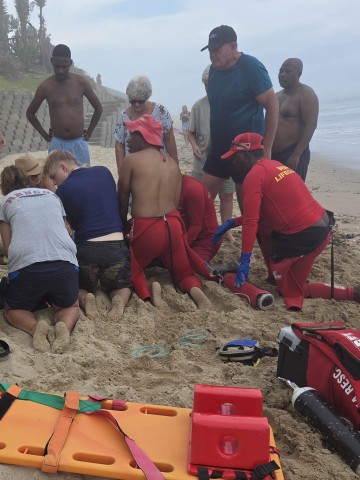
At this point, the lifeguards, who had been brought in from other areas for December, stood back, looking unsure of what to do. James, who holds a Level 3 first aid certificate attained at school as well as his Basic Life Support for Healthcare Providers qualification, quickly sprang into action.
“I checked for a pulse and there wasn’t one, and he wasn’t breathing,” said James “At that point he could have been ‘clinically classified as dead’, so I immediately started CPR.”
While performing CPR, James instructed the lifeguards and surrounding public to contact emergency services and get an automated external defibrillator (AED) down to the beach.
The lifeguards began using an aspirator on Singita under instruction from James, who performed CPR for 15 minutes straight, before being relieved. At this point, James inserted an oropharyngeal airway device, a curved tube inserted into the throat of a patient, in order to hold back the tongue and allow the aspirator to function more effectively. The team then took turns doing CPR for nearly 2 hours.
While waiting for the emergency services, James says the community quickly assisted by bringing blankets for the man as well as water for the lifeguards and James. An AED eventually was brought to the scene, which showed that no shock was necessary as a small heartbeat had been detected.
When the ambulance eventually arrived from East London almost 2 hours later, James immediately brought the paramedics up to speed on the situation. He continued to assist the paramedics while they administered various medications and moved Singita onto an ECG device and intubated him, after which the paramedics finally managed to stabilise him so that he could be transferred to a hospital in East London.
At this point, the lifeguards, who had been brought in from other areas for December, stood back, looking unsure of what to do. James, who holds a Level 3 first aid certificate attained at school as well as his Basic Life Support for Healthcare Providers qualification, quickly sprang into action.
“I checked for a pulse and there wasn’t one, and he wasn’t breathing,” said James “At that point he could have been ‘clinically classified as dead’, so I immediately started CPR.”
While performing CPR, James instructed the lifeguards and surrounding public to contact emergency services and get an automated external defibrillator (AED) down to the beach.
The lifeguards began using an aspirator on Singita under instruction from James, who performed CPR for 15 minutes straight, before being relieved. At this point, James inserted an oropharyngeal airway device, a curved tube inserted into the throat of a patient, in order to hold back the tongue and allow the aspirator to function more effectively. The team then took turns doing CPR for nearly 2 hours.
While waiting for the emergency services, James says the community quickly assisted by bringing blankets for the man as well as water for the lifeguards and James. An AED eventually was brought to the scene, which showed that no shock was necessary as a small heartbeat had been detected.
When the ambulance eventually arrived from East London almost 2 hours later, James immediately brought the paramedics up to speed on the situation. He continued to assist the paramedics while they administered various medications and moved Singita onto an ECG device and intubated him, after which the paramedics finally managed to stabilise him so that he could be transferred to a hospital in East London.
Following the scare, James was invited to the lifeguards’ headquarters where he assisted them with additional first aid training as well as a review of their emergency medical equipment to ensure they are better prepared for possible future incidents.
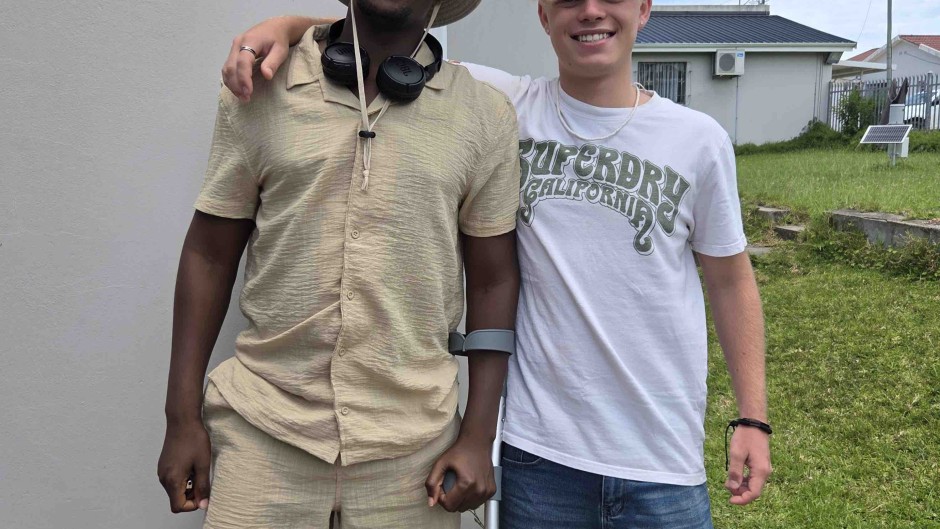
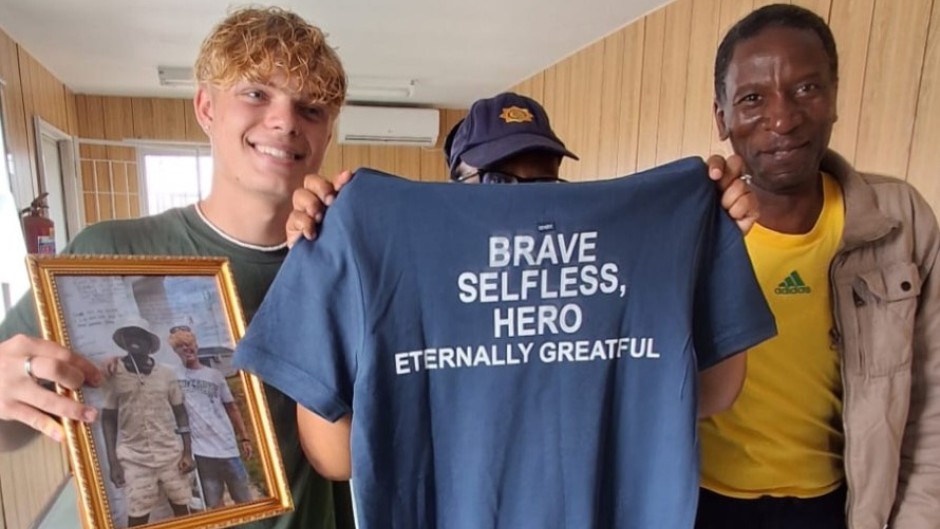
The Kei Mouth Police Station then invited James back to the station where the Chief of the station personally thanked James and presented him with a ‘Hero’ shirt as well as a framed photograph of him and Singita meeting once he was discharged from hospital, with personal messages from other officers to thank him for saving their colleague.
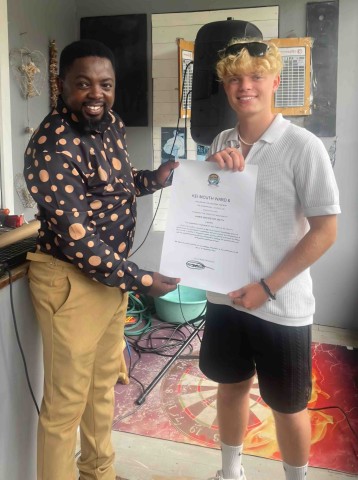
Furthermore in a special ceremony, the Honourable Councillor of Kei Mouth Ward 5, Zuko Patuluko, formally presented James with the ‘Freedom of the Town’ award in recognition of his courage, making James the first recipient of such an honour in the region.
James is a keen first aider who volunteers at the local public clinic in Johannesburg where he has amassed over 100 hours while also being an active member of his school first aid team. He volunteers at different events such as a local bicycle park and is always looking for ways to make a difference.
With a childhood ambition of becoming a doctor, James says that his journey into healthcare really began with the school first aid team and he attributed the training and attention Dainfern College gives to the programme to being vital to his development.
“I would trust my [Dainfern College] first aid team with my life,” he said. “I know how good the programme is as I know how hard the students work. I definitely would not have been able to do what I did there without it.”
Andrew Baker, Executive Head of Dainfern College, expressed the College’s incredible pride in James: “James acted without hesitation to help save a human life in a crisis situation, showing initiative, leadership and great personal courage. We are so proud of him as he epitomises all the attributes Dainfern College strives to instil in our students.”
James has assisted at several road accidents and dreams of becoming a trauma surgeon one day. “If there’s one piece of advice I could give others, it would be do your first aid course,’ he said. “It’s not very expensive and the benefit outweighs any time lost or money spent on it.”
James’ training certainly made all the difference in helping to save the life of a young policeman.