
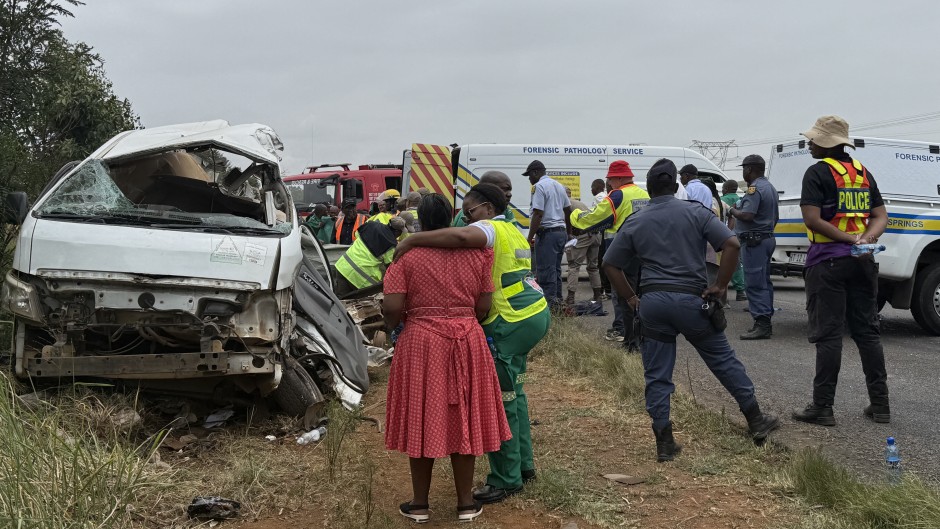
VANDERBIJLPARK - Just days into the 2026 academic year, tragedy has already struck South Africa’s roads.
At least 13 schoolchildren were killed while travelling to school in the Vaal on Monday.
The crash occurred on a narrow road near Vanderbijlpark, a route notorious for reckless truck driving.
Twelve pupils died at the scene, while one later succumbed to injuries in hospital.
The driver of the scholar transport survived the crash.
Police have since opened 13 counts of culpable homicide.
READ | Police probe deadly Vaal crash after 13 pupils killed
Not an isolated incident
On the same day, across the provincial border in the North West, the South African Human Rights Commission (SAHRC) released a damning report on the state of scholar transport in the province.
The commission found that scholar transport conditions in the North West violate basic human rights.
It revealed that the most affected pupils are from poor and rural communities, as well as learners living with disabilities.
READ | Scholar transport | KZN vows to take unroadworthy vehicles off the road
Many pupils are forced to walk long distances to school.
Those who do secure transport often travel in overloaded and unroadworthy vehicles -- some of which are not even minibuses
Deaths in numbers
Statistics South Africa paints an even grimmer picture, revealing that between 2018 and 2022, more than 800 schoolchildren died in scholar transport-related accidents.
These figures form part of a long trail of tragedies that have rocked communities nationwide.
In October 2025, a Grade R pupil from Ga-Molepo village in Limpopo was killed after being struck by a scholar transport bus.
In July 2025, at least 20 pupils were injured when a scholar transport minibus overturned near West Park Cemetery in Gauteng.
KwaZulu-Natal was also hit by a spate of deadly scholar transport crashes in September 2025.
Where are we going wrong?
Authorities point to human error as a major contributing factor.
Road Traffic Authority spokesperson Sello Maremane says nearly 80 percent of road crashes are caused by human behaviour.
He refers to many drivers as “chance-takers”, explaining that while they are aware of the rules of the road, they choose to ignore them, often with deadly consequences for children.
Beyond the statistics, however, lies the lasting trauma endured by families.
READ | Scholar transport | KZN vows to take unroadworthy vehicles off the road
Picking up the pieces
Clinical psychologist Dr Keitumetse Mashego warns that survivors -- including children who were in the vehicle but lived -- may experience survivor’s guilt, requiring long-term counselling and psychological support.
She says the tragedy also highlights broader systemic failures, with many parents left with no alternative but to rely on scholar transport because schools are located far from their homes.
A shared responsibility
These concerns are echoed by National Association of School Governing Bodies representative Matakanye Matakanye, who has called for stricter policies and regulations.
He says governing bodies should enforce rules stating that no parent or school should allow a child to use transport that is unroadworthy or driven by an unlicensed driver.
Such measures, he argues, would empower communities, schools and parents to better monitor scholar transport.
READ | Lifeless bodies, community in shock– Eyewitness recounts Vaal horror crash
However, he stresses that responsibility does not end there.
Matakanye adds that scholar transport vehicles should be clearly identifiable, making it easier for communities to spot unsafe vehicles and report them before another tragedy unfolds.