
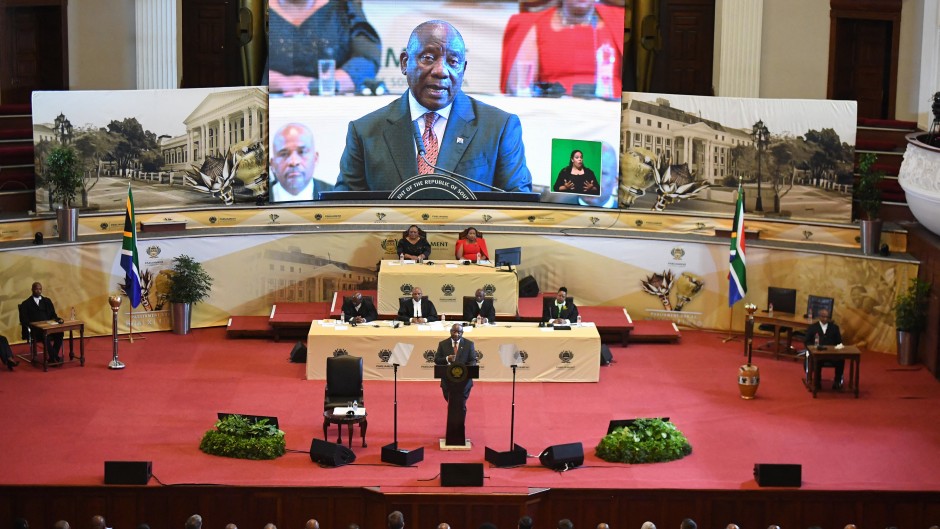
JOHANNESBURG - Jobs, water, infrastructure, poverty and safety were among the biggest promises made by President Cyril Ramaphosa during last year’s State of the Nation Address (SONA).
As we prepare for the next SONA, a key question remains: Have these commitments translated into real change?
Last year’s address outlined an ambitious programme centred on economic growth, job creation, service delivery and social support.
Government pledged to build a capable state, fix failing municipalities, invest in infrastructure and tackle poverty and inequality.
Below are some of the most significant promises made, and what they reveal about government’s priorities.
Growing the economy and creating jobs
Government committed to driving inclusive economic growth and job creation through the Medium-Term Development Plan (MTDP), with the goal of lifting economic growth above 3 percent.
The plan was positioned as the foundation for reducing poverty and improving living standards.
"Our most urgent task is to grow our economy so that we can create jobs, reduce poverty and improve the lives of all South Africans," Ramaphosa said.
READ: What to expect from SONA 2026: Continuity, cautious reforms and few surprises
The official unemployment rate decreased to 31.9 percent in the third quarter of the year from 33.2 percent in the second quarter.
"As in previous years, the economy will form the backbone of the address," said Professor Dirk Kotze, a professor of political science at the University of South Africa.
"Job creation, inequality and black economic empowerment are expected to dominate the narrative, alongside cautious optimism about early signs of economic improvement."
Fixing failing municipalities
The president acknowledged widespread service delivery failures across municipalities, including deteriorating roads, unreliable water and electricity supply, uncollected refuse and sewage spills.
Government pledged to establish professionally managed, ring-fenced utilities for water and electricity services, review the municipal funding model and develop a new White Paper on Local Government.
These commitments signalled recognition that local government is at the centre of South Africa’s service delivery crisis, but also highlighted the scale of reform required.
READ: SONA 2026 | Scepticism ahead of another promise-laden speech
"Addressing local government's poor service delivery is a serious issue," said Outa CEO Wayne Duvenage.
"Just one example is the fact that raw sewage pours into our rivers every day, which is an issue that can be addressed through government, business and civil society partnerships -- with the inclusion of regulations to divert municipal sewage revenue and other actions to hold municipal management to account.
"The lack of meaningful action or interventions by the President suggests he and his cabinet are incapable of tackling these big issues."
Massive infrastructure investment
Government announced plans to spend more than R940-billion on infrastructure over three years, including R375-billion by State-Owned Enterprises.
It also committed to unlocking R100-billion in infrastructure financing through partnerships with local and international investors and improving public-private partnership frameworks.
Infrastructure investment was framed as a key driver of economic growth, job creation and improved service delivery.
"This funding will revitalise our roads and bridges, build dams and waterways, modernise our ports and airports, and power our economy," Ramaphosa said.
Kotze said local government is expected to receive particular attention, especially ahead of upcoming elections.
"Service delivery failures, infrastructure decay, corruption, skills shortages and the instability of coalition governments are likely to be emphasised," he said.
But Duvenage is sceptical.
"In essence, what we hear is rhetoric to stabilise poor performing SOEs, job creation, poverty alleviation and addressing service delivery, better law enforcement, smart cities and more, with little to show for it," he said.
"SONA has seen repeated announcements of task teams, frameworks and pilot implementation plans that have largely gone without impact or implementation."
Tackling the water crisis
Water security emerged as an urgent national priority, with government acknowledging growing shortages caused by failing infrastructure and delayed projects.
Plans included accelerating major water infrastructure projects such as the Lesotho Highlands Water Project Phase 2, the uMkhomazi Dam and the Ntabelanga Dam, as well as establishing a National Water Resource Infrastructure Agency and introducing stricter regulation of water service providers.
Government promised decisive action to ensure reliable access to water across urban and rural communities.
READ: SONA 2026 | SA's water crisis worsening, warns WaterCAN
"Many people in our cities, towns and villages are experiencing more and more frequent water shortages as a result of failing water infrastructure," Ramaphosa said.
"It is impossible to live without water, and it is impossible for the economy to grow without water."
The consequences of water insecurity are felt most acutely at ground level.
Dr Ferrial Adam, Executive Director of WaterCAN, highlighted the impact on informal settlements, peri-urban communities, and low-income households, where weak infrastructure, high costs, and tanker failures leave residents vulnerable.
"Water affects everything we do," she said.
Supporting black-owned and small businesses
Government pledged to establish a R20-billion-a-year transformation fund over five years to support black-owned and small enterprises.
It also committed to fast-tracking regulations under the Public Procurement Act to improve access to government contracts for women, youth and persons with disabilities, alongside expanded training programmes for entrepreneurs.
"Through these programmes, we are not only righting a grave historical wrong, we are unleashing the potential of our economy for sustained growth," Ramaphosa said.
READ: SONA 2026 | BBC says R20bn transformation fund still not a reality
"We want a nation where there is work for all, where every person can earn a decent living and realise their potential."
But the Black Business Council (BBC) says nothing has changed in the past 12 months.
"Unfortunately, nothing has been done regarding these regulations, and no one from National Treasury has said anything about this important matter for black business," said the BBC’s Masedi Sesele.
"Even though there has been some discussion about the fund, it is not in place as we speak."
Expanding youth employment programmes
The Presidential Employment Stimulus and related initiatives were highlighted as key tools to address youth unemployment.
Government reported that these programmes had created millions of work and livelihood opportunities, with further expansion planned to scale up youth employment.
"We now need to build on these innovative programmes to create jobs for the youth on an even greater scale," Ramaphosa said.
READ: Youth unemployment still entrenched despite government’s job creation claims
Youth Employment Service (YES) CEO Ravi Naidoo says the problem is not a lack of effort, but a lack of coordination, long-term focus and alignment with the real needs of the economy.
"There are no quick fixes to sustainable youth employment," Naidoo said.
"To make meaningful progress, we need large-scale programmes that are closely linked to what the economy needs and maintained for at least ten years."
Reducing poverty and strengthening social support
Government emphasised its commitment to social protection, noting that around 60 eprcent of the national budget is spent on the social wage, including health, education, social grants and public employment programmes.
Millions of vulnerable South Africans continue to benefit from social grants, fee-free education and financial aid for tertiary studies.
While these programmes have helped to alleviate poverty, government acknowledged that more needs to be done to address hunger and inequality, particularly among women and children.
"We want a nation where no one goes hungry," Ramaphosa said.
"But we have to do much more if we are to end poverty. We must do much more to ensure that women, in particular, no longer face a hopeless struggle to feed and clothe their children."
READ: SONA Promises vs reality | Hunger and poverty still plague SA, says expert
Dr Kelle Howson, a senior researcher on workers’ rights and social security, said these commitments have not resulted in meaningful progress for vulnerable communities.
Howson points to a continuation of austerity policies that have eroded social spending in real terms.
"Most egregiously, National Treasury is actively working to reduce the number of people receiving social grants, by placing conditions on the South African Social Security Agency's operating budget, requiring it to implement draconian and flawed means-testing and identity verification procedures which will exclude many of the most vulnerable," Howson said.
She said that although the social grant system has historically played a significant role in reducing extreme poverty, its impact is now being eroded.
Strengthening the fight against gender-based violence
Government committed to strengthening the national response to gender-based violence (GBV), including fully operationalising the National Council on GBV and Femicide, expanding shelters and Thuthuzela Care Centres, and increasing the number of sexual offences courts.
"There are now 65 Thuthuzela Care Centres across the country.
"Out of 52 districts in the country, 44 have GBV shelters," the president said.
He said all police stations in the country have victim-friendly services, and another 16 sexual offences courts would be established in the next financial year.
READ: SONA 2026 | Do South Africa's GBV structures really work?
While these developments mark important structural progress, Dr Shadeda Omar from the Teddy Bear Clinic cautioned that outcomes for survivors still vary widely depending on geography, funding and system capacity.
Dr Omar unpacks what is working, what is not, and what still needs urgent attention.
Looking ahead, Dr Omar said meaningful progress would require concrete, measurable commitments in the next SONA.
Service expansion and infrastructure: Clear timelines for achieving full national coverage of TCCs, shelters, and sexual offences courts and dedicated funding to scale victim support services and safe transport for survivors.