
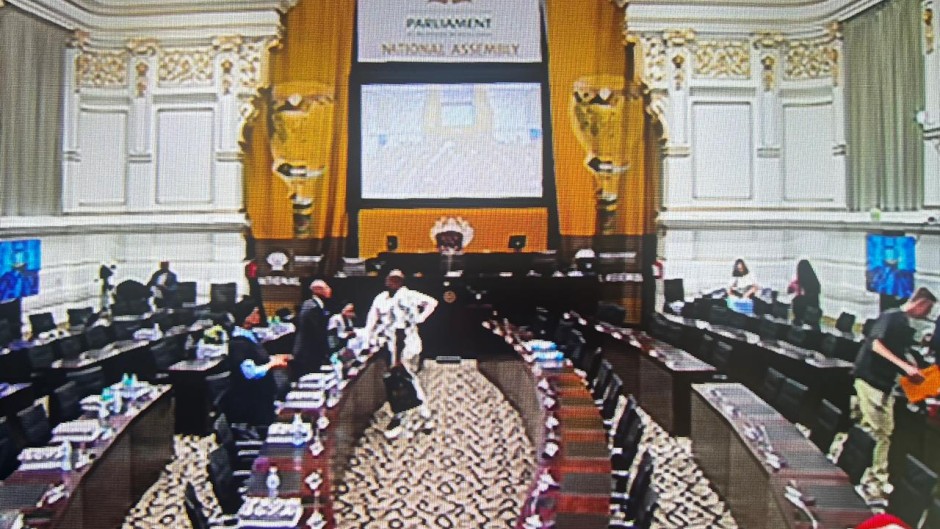
JOHANNESBURG - Parliament's Ad Hoc Committee to investigate allegations made by Lieutenant General Mkhwanazi concluded its work on Wednesday.
The Committee kicked off its work in October and testimonies have been dramatic.
In July last year, the National Assembly (NA) agreed to establish an Ad Hoc Committee to investigate claims of corruption and collusion between criminals and law enforcement agencies.
Members of Parliament then adopted a report from the Police and Justice Portfolio Committees. At the Committee's establishment, the Economic Freedom Fighters (EFF) said they would not allow the committee to become a mere tick-box exercise.
READ: SAPS ad hoc committee | Mkhwanazi says Minister Mchunu did not consult him before disbanding PKTT
Four ANC MPs, two from the DA, two from the MK Party, one from the EFF and one each from the PA and IPP made up the committee that was chaired by ANC MP, Soviet Lekganyane.
The Committee ran in parallel with the Madlanga Commission that kicked off it's operations a month before that.
Prior to his testimony at the Committee, Mkhwanazi first testified at the Madlanga Commisson over three days where he implicated DA MP Dianne Kohler-Barnard. He alleged that she sabotaged crime intelligence by leaking classified information for political gain.
READ: Kohler Barnard asked to recuse herself at first day of Mkhwanazi's testimony
His sharp rebuke came after Kohler-Barnard’s 2012 affidavits, in which she accused him of covering up a deadly police shooting.
She was asked to recuse herself on the first day of the proceedings
Mkhwanazi's testimony continued at the Ad Hoc Committee after EFF leader, Julius Malema accused Mkhwanazi of submitting a supplementary statement and not an original statement like at the Madlanga Commission.
Malema said the Committee could not depend on a statement made to the Commission. He argued Parliament is not subordinate to any other inquiry.
National Commissioner Fannie Masemola was the second witness to appear before the Committe. He assured MPs that the South African Police Services is not in a state of crisis.
Masemloa admitted that challenges are both external and internal and efforts to root out those internal issues are underway.
While the Committee continued the homes of suspended Deputy Commissioner Shadrack Sibiya and Mchunu's Chief of Staff Cedrick Nkabinde were raided by the Special Investigating Unit (SIU).
READ: Masemola tells Ad Hc Committee that SAPS is not 'in a state of crisis'
Sibiya called the action a witch hunt against him.
At first he denied knowing alleged underworld boss Vusimuzi 'Cat' Matlala beyond contractual work with the SAPS. He also told the committee that Brown Mogotsi warned him about people who wanted to chase him out of the police.
Sibiya also dismissed suggestions that the PKTT was dissolved to derail cases linked to drug cartels in Gauteng.
When talking about Mkhwanazi, Sibiya said the country has created a monster that no one is able to control.
Police Minister Senzo Mchunu has clarified that the PKTT was set up solely to tackle political murders in KwaZulu-Natal, not as part of routine police operations.
Mkhwanazi had stressed that the task team was established in response to the province's relentless political bloodshed.
READ: Discussion | SIU raids take place as ad hoc committee into SAPS turmoil meets
He said he sought legal advice before ordering the disbandment, and insists the decision was legal and constitutional.
READ: Mchunu defends PKTT disbandment saying SAPS serves everybody
Mchunu also defended his decision, saying the SAPS has a mandate to serve and protect all South Africans, not just councillors.
The Committee also exposed some 'experts,' like Mary De Haas. De Haas, who was known as a professor was exposed to not having such a designation.
The University of KwaZulu-Natal (UKZN), whom she had been associated with for many years, distant itself from her apparent work at the university.
READ: Ad hoc committee | Mary De Haas testifies before parliament
They confirmed that she was neither professor, nor was she a lecturer at the University. She last worked at the University of Natal in 2002 before it merged with the University of Durban-Westville in 2004 to form UKZN.
De Haas was accused by Mkhwanazi for influencing Mchunu to shut down the PKTT by writing to him. During her testimony she denied.
Sibiya and Nkabinde both subsequently also appeared before the Committee.
MPs took the opportunity to grill Matlala, as well as SAPS Lieutenant General Puleng Dimpane.
Bags full of cash for bribes, alleged drug-trade links and claims of cellphone evidence tampering dominated proceedings.
READ: 'Cat' Matlala's 'unsigned statement' stirs disagreement among MPs
Matlala admitted he's no saint but has attempted to deflect the blame, saying he’s being failed by the system.
He also admitted to handing out R500,000 in two separate bribery payments to former Police Minister Bheki Cele.
Other notable appearances before the Committee were suspended crime intelligence boss Dumisani Khumalo. He had appeared at the Madlanga Commission before falling ill. Upon recovery, he appeared in Parliament before returning to the Commission.
Former Independent Police Investigative Directorate Head Robert McBride's testimony got off to a shaky start after MPs accused him of being arrogant and disrespectful.
READ: LIVESTREAM | Dumisani Khumalo appears before Ad Hoc Committee
He faced claims that he and forensic investigator Paul O'Sullivan plotted to oust then Acting National Police Commissioner Khomotso Phahlane.
After a spirited appearance at the Madlanga Commission, suspended Ekurhuleni Metro Police Deputy Chief Julius Mkhwanazi also made it to the Committee
After pressing the Ad Hoc Committee for weeks to pay for his security and his accommodation in Cape Town, North West businessman Brown Mogotsi finally showed up.
He repeated the very same allegations to the Committee of being a former agent, which no one bought.
READ: ‘I didn’t take an oath to answer every question,’ says O’Sullivan
The Committee's testimony came to a head in March 2026 when forensic investigator Paul O'Sullivan finally agreed to appear.
Things got heated when MPs asked him to apologise for his utterances on eNCA's Crime Watch weeks prior.
After storming out, he returned to finish his testimony.
Senior police official Hilda Senthumule insisted controversial businessman Vusimusi 'Cat' Matlala did not sponsor her cosmetic surgery.
She caused a stir by showing off her figure at the Ad Hoc Committee in Parliament as she addressed the allegations directly.
She even joked about the public fascination with the procedure.
READ: 'It's a national asset' : Senthumule shows off her figure in Parliament
She said the procedure was done on 16 October and paid for with her own money.
Sibiya accused Senthumule of financially benefiting from Matlala.
He told the Madlanga Commission that she allegedly underwent a Brazilian Butt Lift procedure reportedly paid for by the alleged criminal kingpin.
Sibiya claimed the financial aid was never disclosed to the SAPS and could well amount to a conflict of interest.
READ: Ramaphosa responds in writing to Parliament’s Ad Hoc Committee questions
On Monday and Tuesday Masemola and Mkhwanazi appeared at the Committee for the last time. President Cyril Ramaphosa also submitted his written response to the Committee saying that he was not briefed about the closure of the PKTT by Mchunu.
MPs said the real work of analysing the evidence has only just begun.
They are now working towards their end-of-March deadline to submit their findings and recommendations to the Speaker of Parliament.
Lekganyane said MPs have agreed on a list of activities that will be happening. These include a workshop on Constitutional principles that will underpin the report's writing.