
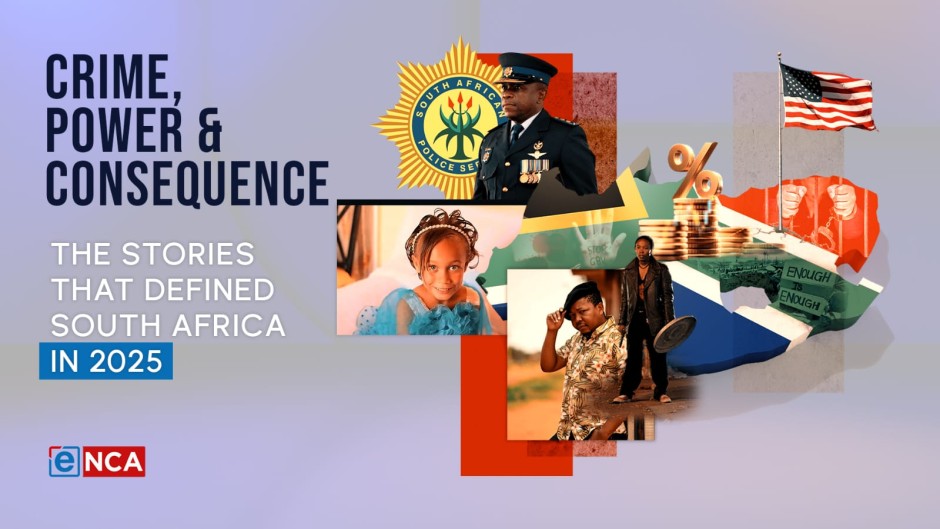
GAUTENG - In 2025, South African stories unfolded in plain sight with protests over water and street clashes with police.
In courtrooms, mothers stood trial for murder as the justice system waged its own battles.
It was the year when senior police officials publicly accused politicians of shielding crime syndicates.
This forced the country to confront one burning question: Who really controls the criminal justice system?
Mkhwanazi's bombshell allegations
When KwaZulu-Natal Police Commissioner, Nhlanhla Mkhwanazi, made his explosive allegations on the 6th of July, it revealed the cracks in a once picture-perfect criminal justice system.
Mkwanazi made a series of damning allegations against Police Minister, Senzo Mchunu, and Deputy National Commissioner, Shadrack Sibiya.
Read | SAPS in turmoil amid allegations of interference and corruption
He told the media that evidence found on the phone of accused underworld figure Vusimuzi ‘Cat’ Matlala linked the minister to unauthorised communications through an associate, Brown Mogotsi.
Mkwanazi went on to say that the rot ran deep: law enforcement and politicians aided drug cartels, especially in Gauteng.
Corruption consequences come home
What followed were two inquiries, one judicial and one parliamentary.
The Madlanga Commission, which had a delayed start in September, and the Ad hoc Committee to investigate allegations made by Mkhwanazi began proceedings in October.
The two inquiries dominated headlines for months, keeping the country glued to its screens.
While commissions were being announced, in the courts, families continued to wait for justice.
Criminal cases in court
The extradition of the Ndimande brothers from Eswatini brought renewed hope to those mourning the murders of rapper Kiernan “AKA” Forbes and his friend Tebello “Tibz” Motsoane.
In another courtroom, the Senzo Meyiwa trial continued to drag on, over a decade since the football star’s death. After three years of evidence, the state finally closed its case, clearing the way for the defence.
The sentencing of underworld figure Nafiz Modack offered a moment of relief.
The corruption conviction followed a bombshell plea deal from former police officer Kolindren Govender, who admitted to 51 charges and confessed to shielding Modack from police in exchange for R150,000 in bribes.
As the legal system came under the spotlight, politics proved no safer from scandal.
The political leadership revolving door
Senior leaders were suspended and removed amid corruption allegations and charges of abuse of power.
DA deputy minister, Andrew Whitfield, was removed from his position in June. Dion George was also removed from his post as Forestry, Fisheries, and Environment Minister.
George was dismissed after he reported DA party leader, John Steenhuisen, for allegedly misusing his party credit card.
Senzo Mchunu was suspended from his position as Police Minister following Mkhwanazi's corruption claims.
The Umkhonto weSizwe Party (MKP) also faced instability.
The public saw the party's former secretary-general, Floyd Shivambu demoted to an ordinary member. Then, in November, its parliamentary Chief Whip, Colleen Makhubele, was replaced by Des van Rooyen.
Overnight, party president Jacob Zuma reinstated Makhubele and suspended his deputy, John Hlophe.
Brumelda Zuma was sworn in as a parliamentary MP in early December, replacing her sister, Duduzile Zuma.
National financial turmoil
Staying in the world of politics, the first year of the Government of National Unity was marked by high-stakes conflict.
The National Budget was postponed three times in 2025, for the very first time in democratic South Africa.
Finance Minister, Enoch Godongwana, faced legal challenges from political opponents following an attempt to introduce a 0.5% VAT increase.
Read | Budget 3.0 | Unpacking the Finance Minister's revised plan
Budget 3.0 was finally tabled at the end of May.
Gender-based violence and femicide
For women and children, 2025 was yet another brutal year.
The rape of seven-year-old Cwecwe horrified the nation and reignited long-standing anger over gender-based violence.
Names like Joshlin Smith and Olorato Mongale became painful symbols of lives lost in a country where violence against women and children remains widespread.
By November, protests had grown so intense that the government was forced to declare gender-based violence and femicide a national disaster.
Weather warnings as storms wreak havoc countrywide
Nature showed little mercy.
The country faced several major weather events this year. Floods that led to property damage, injuries, and deaths, particularly in Kwa-Zulu-Natal and the Eastern Cape.
Storms in Gauteng and Mpumalanga in September, and cold fronts that brought freezing conditions, pushed climate change into sharp focus.
In memoriam
And as the year went by, South Africans also said goodbye several notable individuals.
The deaths of actor Presley Chweneyagae, former minister Nathi Mthethwa, and former SARS commissioner Oupa Magashula made many reflect.
Others, like DJ Warras, who was shot and killed in the Joburg CBD, made security specialist Mike Bolhuis question whether protection orders mean anything to major crime syndicates.
Read | DJ Warras killing highlights limits of protection orders, says security expert
This, after it emerged, DJ Warras, outspoken about reclaiming the inner city, had secured five protection orders before his murder.
Bolhuis said that killings were up more than 10%, calling 2025 “the year of the gun,” with criminals using firearms to settle scores.
SA-US relationship hits the rocks
Beyond our borders, the country’s relationship with the United States deteriorated sharply.
President Cyril Ramaphosa led a delegation aimed at resetting relations with the country. They also planned to correct false allegations of white Afrikaner oppression.
US President Donald Trump threatened South Africa with tariffs. He boycotted the G20 Leaders' Summit in November, stealing SA's thunder as the summit was held for the first time on African soil. He has now excluded South Africa from participating in the next G20 proceedings, a matter that remains in contention.
Read | Presidency warns US against excluding SA from 2026 G20
These stories did more than capture ‘the year that was, ’ they charted the country’s struggle with crime, corruption, violence, and loss.
But this was also a year when people demanded answers and accountability.